
TL;DR
- A part can be rhythmically correct and still sound amateur if three different clocks disagree: when you play, where the DAW places the note, and when the ear believes the sound starts.
- Before you buy new gear or another plug-in, run the 3-Clock Timing Audit: check note placement, sound attack, and monitoring latency in that order.
- According to the 16th note rhythm at 100 BPM/150 ms duration of that 16th note will result from all latencies (12 ms from parts latency to original tempo & 20 along with patches approximately). So by the time you use above one-fifth of total time between notes as intended.
- Hard quantize is not a universal fix. Strength, groove, swing, and selective nudging usually sound better than forcing every note to the grid.
- Use wired monitoring, a low-latency recording setup, and short-attack reference sounds when you diagnose timing. Otherwise, you may edit the wrong problem.
Many artists and music producers make poor decisions on where to allocate their finances when a piece of music sounds amateurish. Instead of working on fixing the actual notes in their song, they will change their sample libraries, buy brighter synthesizers, upgrade their audio interface, and begin using more and more mix plug-ins. In most cases, the notes themself can be fine. The main issue is that the feel of a song is off when the listener goes to grab onto the note itself.
Thus, it is a technical issue and technically, a budgetary issue as well, if diagnosed correctly, can easily be fixed by modifying a setting in the system, making a better editing decision or doing a cleaner performance pass than was previously done. On the contrary, if improperly diagnosed you could lose a large amount of actual money before obtaining a tighter version of the finished product.
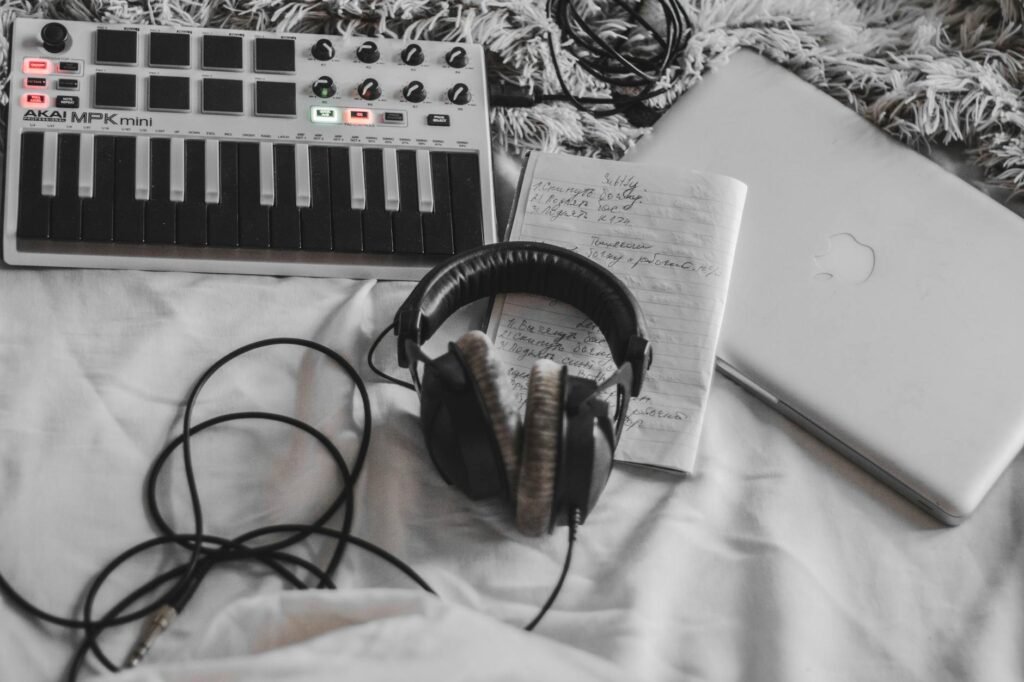
The real issue is that you are hearing three different clocks
The hidden timing problem is that musical timing does not live in one place. There is the performance clock, which is when your hands or voice move. There is the grid clock, which is where the MIDI or audio event lands. Then there is the sound clock, which is when the ear experiences the note as arriving. Research on musical timing shows listeners can detect small timing changes, and work on perceptual centers shows that the perceived temporal location of a sound is not always the same as its physical onset. (pubmed.ncbi.nlm.nih.gov)
That is why good notes can still read as cheap. A soft pad, bowed texture, or slow-attack piano layer can make an accurately placed part feel late. A high-latency monitoring chain can train you to compensate in the wrong direction. And a hard-quantized edit can clean up the grid while flattening the very relationships that make a part feel intentional. Microtiming often lives in deviations small enough to look harmless on screen, commonly under 50 ms, yet still shape groove and perceived quality. (sciencedirect.com)
Use the 3-Clock Timing Audit before you edit or spend
A way to quickly determine if a performance issue is more likely to be a result of sound design or something set up. Use a scoring from 0-2 with 0 being (clean), 1 (suspicious), and 2 (obviously creating a problem). Determine a problem that scores the highest, and fix it first. If your monitor has a score of 2, fix that before re-recording or moving any notes (you will just change something that the setup created).

| Clock | What to listen for | Fast test | Score it 0-2 | Cheapest first fix |
|---|---|---|---|---|
| Placement clock | Does the note start early, late, or inconsistently against the groove? | Switch to a short, percussive sound and compare the same phrase to the click. | 0 = stable, 1 = occasional drag/rush, 2 = obvious slop | Re-record small sections or nudge only the offenders |
| Sound clock | Do notes feel late only on certain patches or layers? | Play the same MIDI with a pluck or closed hi-hat-style sound, then with the original patch. | 0 = same feel, 1 = slightly later, 2 = clearly later | Shorten attack, trim layers, or move that sound slightly earlier |
| Monitoring clock | Does your timing get worse while recording than after editing? | Record once through your normal chain and once through a low-latency, wired chain. | 0 = no change, 1 = slight improvement, 2 = major improvement | Lower buffer, bypass latency-heavy plug-ins, avoid Bluetooth |
When it comes to performing an audit, the goal is not to achieve perfection, but rather to perform triage. Most home studio musicians create a grid edit first because the grid is the most visually prominent. However, in many cases, this is backwards. If the issue is with the sound clock or the monitoring clock, the edits to the grid could make the performance appear tighter but not feel as comfortable.
A concrete example at 100 BPM
An easy example of an element being delivered late is the keyboard part of 100 BPM. If a quarter note has an average time of 600 ms, then a 16th note has an average time of 150 ms. If the player fall behind by only 12 ms on average, that is not going to look like that big of a deal on a piano roll.
However, because the patch that was used to play this part has a slow front end, there will be an additional delay of at least 20 ms between when the sound arrives at the source and when the ears can lock into the note, which means the note now effectively has a delay of 32 ms from the groove (or timing).
That is more than one-fifth of a 16th note at this tempo. In other words, the performance did not need to be wildly wrong to start sounding underpowered. Studies on expressive timing found listeners could perceive timing changes as small as 20 ms in some contexts, which helps explain why a part can feel amateur even when the screen says it is close. (pubmed.ncbi.nlm.nih.gov)
Incidentally, this could also lead someone to make poor spending choices because if you hear the sound of a drag and immediately think of having to buy something new such as another piece of gear (like a new instrument), or a premium preset pack, or more plugins, then before resolving the delay issue with your equipment that you are already experiencing (the 32ms delay) you could easily have spent $100-$300.
What usually creates the amateur feel
1) Slow attacks make accurate notes feel late
The same MIDI can feel tight on a pluck and late on a pad because the ear does not always lock to the first microscopic moment of the waveform. It locks to the perceptual front edge. If you judge timing only by the piano roll, you miss that. This is why short-attack reference sounds are so useful during diagnosis. If the phrase suddenly tightens up on a percussive patch, you probably have a sound-clock problem, not a playing problem. (pmc.ncbi.nlm.nih.gov)
2) Monitoring latency teaches your hands the wrong correction
Official DAW guidance is clear on the broad point: buffer size, converters, plug-ins, and wireless monitoring can all add latency, and smaller buffers reduce input-monitoring delay. Apple also notes that Bluetooth headphones or speakers are for listening or mixing, not for tight recording work. Ableton’s documentation gives a concrete example: at a 256-sample buffer and 44.1 kHz sample rate, the expected latency before the signal enters Live is about 5.8 ms, and total session latency can be higher depending on the path. (support.apple.com)
3) Full-strength quantize fixes position but can flatten feel
Modern DAWs give you more than on-or-off quantize for a reason. Logic documents quantize strength and swing, Smart Quantize preserves relative positions in many situations, Ableton’s Groove Pool lets timing be applied by degree, and Cubase supports groove-based quantizing from a MIDI part or audio loop. The practical takeaway is simple: if the performance already has intent, use the lightest correction that restores clarity. (support.apple.com)
4) Note length exposes bad timing even when note starts are fine
Many musicians only monitor the note-on event for an instrument. The reason for this is because weak relaeases, long sustain and poor duration control can create a random sound in a part that otherwise would be considered tight.
This is apparent in many examples, such as in chords, multiple layers of sound, muted guitar parts, and rhythm based synthesizer performances. If a chord appears to be playing correctly, yet it still plays out of time, look at the the note-end point and determine the relationship of how long two sounds are.
The reset routine before you touch the grid
- Duplicate the original take so you can compare every edit against the untouched version.
- Swap the sound to a short, bright, percussive patch or sample for diagnosis only.
- Turn off Bluetooth monitoring and switch to a wired path.
- Bypass look-ahead limiters, linear-phase processors, and any plug-ins that obviously increase latency while recording.
- Loop one bar and listen for whether the problem is consistent, random, or tied only to one sound layer.
- Only after that decide whether the fix is re-recording, nudging, changing attack, or light quantization.
The procedure described avoids incurring a large amount of unnecessary costs by attempting to resolve a setup issue through editing and then attempting to resolve the problems caused by the editing with new gear. Another benefit of using this routine is that it prevents you from timing in solo based on the actual problem that relates to kick, snare or bass.
Quantize, nudge, or re-record?
| What you hear | Best move | Why it works | Spend money first? |
|---|---|---|---|
| Nearly every note is offset by the same amount | Nudge the whole phrase or track | A systematic offset is usually a timing-reference issue, not a random performance problem | No |
| Only a few notes drag or rush | Manual edits or a punch-in | Random outliers are usually faster to fix than globally quantizing a decent take | No |
| The part feels late only on one pad or layered patch | Adjust attack or move that sound slightly earlier | You are correcting the sound clock, not punishing the performance | No |
| The groove is right but messy in dense drums or comping | Use partial quantize, strength, or groove extraction | You preserve feel while tightening the obvious misses | No |
| Timing falls apart only while recording with the full mix active | Lower latency and re-record | The hands are reacting to the monitoring chain, not the song | Usually no |
| Several parts are all slightly smeared and the session is overloaded | Print tracks, simplify the template, then retry | System load can push you into compromises that create both clicks and timing hesitation | Maybe, but only after testing a leaner session |
Common mistakes that make timing worse
- Quantizing before checking whether the patch itself is making the note feel late.
- Editing MIDI while still monitoring through a high-latency chain.
- Judging timing on Bluetooth headphones, which official guidance says add latency. (support.apple.com)
- Fixing every instrument to the same grid position even when different sounds have different attacks.
- Leaving note lengths untouched after tightening note starts.
- Listening in solo and missing the fact that the part only drags against kick and bass.
- Assuming the answer is a new interface, new library, or new plug-in before running a no-cost audit.
If the first fix still does not solve it
Timing can often be the only part of your issue related to a problem with sound. However, if your part sounds great after getting all of your sounds in the correct placement, attack and latency, the next thing to check for likely issues will be arrangement density, weak accents, over-layering, or poor note selection on the bar line. In layman’s terms, your line may still have correct timing but won’t communicate as an effective sentence.
- Mute one layer at a time. Two soft attacks stacked together often feel later than either sound alone.
- Thin the voicing on busy chords. Timing sounds worse when the harmony itself is crowded.
- Reduce release times on rhythmic parts so the groove breathes between notes.
- Strengthen the accents that define the pocket instead of trying to quantize every subdivision.
- If the feel is still vague, re-record fewer bars at a time with a stripped-down cue mix.
There is also a genre limit here. A very tight, clipped pop part and a deliberately laid-back neo-soul part should not be edited the same way. One study on drum-pattern quality found that increasing microtiming deviation lowered perceived quality in that test design, and early shifts were rated more harshly than comparable late shifts. That does not mean every style wants maximum grid rigidity. It means you should know which direction of error your track is least willing to forgive. (journals.sagepub.com)
How to verify that you actually fixed it
- Print a before-and-after bounce at the same level. Louder almost always sounds tighter, so match volume first.
- Do a blind A/B with the original. If you consistently pick the new version for clarity but not stiffness, you are probably moving in the right direction.
- Zoom in and check only the notes that define the groove: downbeats, backbeats, and syncopated anchors.
- Listen once on your short-attack diagnostic sound and once on the real sound. If only the diagnostic version feels fixed, you still have a sound-clock issue.
- Take a short break and replay the section cold. Timing problems are easier to hear after your ear resets.
- If possible, compare against one commercial reference in a similar style, not ten different tracks with different grooves.
Editing can result in an inaccurate representation of success, and can also impact how a piece is depicted through the use of eye-catching visuals without showing emotion, or successful delivery. Identifying the best method of achieving an appropriate click count will be determined by determining a solution where there is no longer a perceived timing issue for the user and not simply to provide the clearest representation of the notes through a piano roll interface.
Bottom line
If the notes are good but the overall sound is substandard, it usually has nothing to do with the skillfulness of the musicians, instead, it often comes down to three pretty common technical flaws: mismatches in recorded timing, or time of attack, and/or monitor time delay. You should run a 3-Clock Timing Audit to identify and improve upon the highest-risk clock first so that you have an accurate reason to purchase new equipment when you eventually run out of options. Once this audit is completed, you are now in a good position for developing your technical facility, improving your editing capability and ultimately managing money better.
FAQ
How many milliseconds off is enough to sound late?
It depends on tempo, sound, and context, but it does not have to be a huge error. In one study of expressive timing, listeners detected timing changes as small as 20 ms in certain note contexts. At 100 BPM, 20 ms is already more than 13% of a 16th note. (pubmed.ncbi.nlm.nih.gov)
Why does the same MIDI feel tight on one patch and late on another?
Because the ear does not always treat physical onset and perceived arrival as the same thing. Slow attacks, soft fronts, and layered sounds can push the perceived note later even when the MIDI is unchanged. Research discussing perceptual centers helps explain this mismatch. (pmc.ncbi.nlm.nih.gov)
Should I quantize everything to 100%?
Usually not. Official DAW documentation highlights tools such as strength, swing, Smart Quantize, and groove-based timing because preserving some relative note position often sounds more natural than forcing every event to the nearest grid line. (support.apple.com)
Can latency really change the way I perform?
Yes. Apple and Ableton both document that buffer size, plug-ins, and monitoring path affect latency. If you are hearing yourself late, your hands may start compensating in ways that make the recorded result worse. Wired monitoring and a low-latency record template are the simplest test. (support.apple.com)
When is it actually worth buying new gear?
If you have eliminated low-cost remedies, no component will become tighter at shorter triggers, lighter edits, or via a lower-latency recording configuration than before. Therefore, any deficiencies in record or playback performance could not possibly be caused by your gear – instead, make your financial investment if you have exhausted all other options and are still experiencing instability with low-latency monitoring or if your current system cannot handle the average project loads normally created by users.
References
- Apple Support: Manage input monitoring latency in Logic Pro for Mac – https://support.apple.com/en-us/105040
- Ableton Help: How Latency Works – https://help.ableton.com/hc/en-us/articles/360010545559-How-Latency-Works
- Ableton Live Manual: Using Grooves – https://www.ableton.com/en/manual/using-grooves/
- Apple Support: Quantize timing in the Piano Roll Editor in Logic Pro – https://support.apple.com/guide/logicpro/quantize-the-timing-of-notes-lgcpfa6e7f80/10.7/mac/11.0
- Apple Support: Logic Pro for Mac MIDI quantization types – https://support.apple.com/guide/logicpro/midi-quantization-types-lgcpbc6a2df2/mac
- PubMed: The perception of expressive timing in music – https://pubmed.ncbi.nlm.nih.gov/2756071/
- PMC: Sounds familiar(?): Expertise with specific musical genres modulates timing perception and micro-levelynchron to or – https://pmc.ncbi.nlm.nih.gov/articles/PMC8888399/
- Frontiers: Time Perception for Musical Rhythms: Sensorimotor Perspectives on Entrainment, Simulation, and Prediction – https://www.frontiersin.org/articles/10.3389/fnint.2022.916220/full
- ScienceDirect: A review of psychological and neuroscientific research on musical groove – https://www.sciencedirect.com/science/article/pii/S0149763423004918
- SAGE Journals: Music on the timing grid: The influence of microtiming on the perceived groove quality of a simple drumh – https://journals.sagepub.com/doi/abs/10.1177/1029864913486793