
The habit is simple: you look at a note, identify its letter name, find it on the instrument, and only then play. Many musicians do this so automatically that they mistake it for “good reading.” It isn’t. It’s translation, not fluent reading. Research on sight-reading points in a different direction: stronger readers rely more on pattern recognition, prediction, and auditory representation, while formal pedagogy also emphasizes preview, continuity, and understanding the score before the first note is played. (scholar.usuhs.edu)
TL;DR
- The slowing habit is name-first, note-by-note decoding: treating each symbol as a separate problem instead of reading shapes, rhythm, and musical direction. (scholar.usuhs.edu)
- Skilled sight-readers do not keep their eyes glued to the note they are sounding. Research on eye-hand span shows that fluent readers look ahead, and stronger readers are better at extending or adapting that look-ahead window. (pubmed.ncbi.nlm.nih.gov)
- Exam systems and teaching tools do not reward stop-start perfection. They reward steady flow, quick recognition of key and rhythm patterns, and a studied preview before playing. (abrsm.org)
- You do not need to stop learning note names. You do need to stop using note naming as your main real-time reading strategy. That shift is what often speeds learning up. (scholar.usuhs.edu)
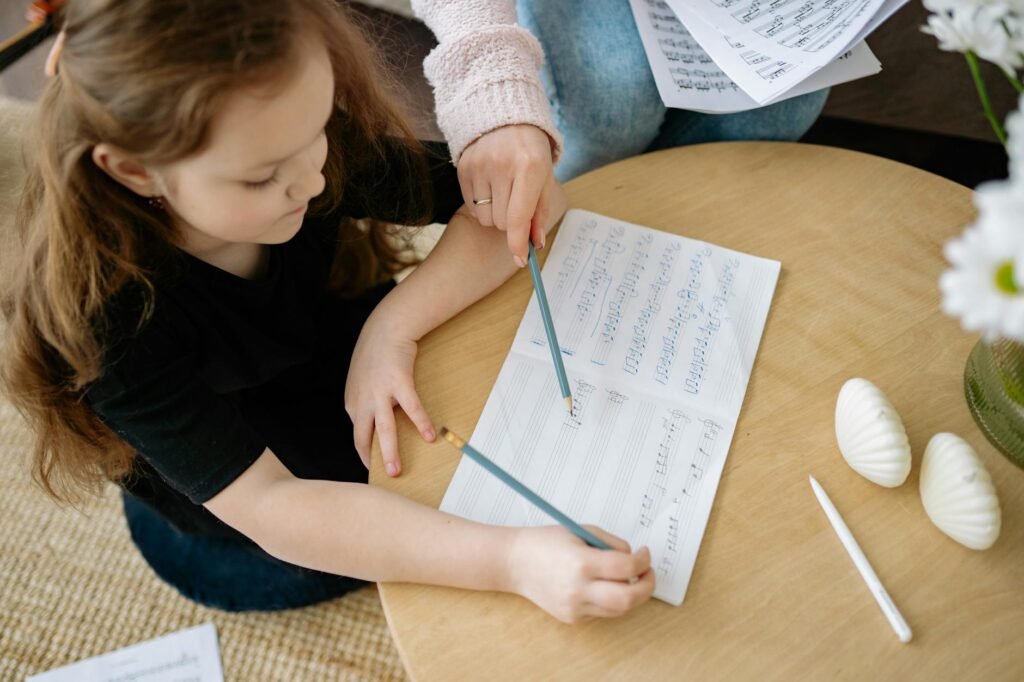
The real problem is not sheet music. It is how you are processing it.
When musicians say, “I read music, but slowly,” they often mean they can eventually decode notation. That is different from reading in time. In a 1998 study of pianists, individual note naming was only one small part of the task battery, while pattern-recognition tasks and the ability to generate auditory representations were more strongly tied to sight-reading skill. In plain English, better readers were not just faster at identifying symbols. They were better at seeing meaningful groups and hearing what those groups implied. (scholar.usuhs.edu)
That helps explain why the note-by-note habit feels safe but wastes time. Every extra mental step adds friction: name the pitch, convert it to a location, check the rhythm, then move. By the time that chain finishes, the beat has already moved on. The Gordon Institute for Music Learning defines audiation as hearing and comprehending music when the sound is absent, and it includes reading as one form of audiation. If the ear is missing from the process, reading becomes much more mechanical. (giml.org)
Why note-by-note decoding slows learning so much
- It shrinks your look-ahead window. Eye-hand span research describes sight-reading as a task in which the eyes normally lead the hands. When reading gets harder, that span tends to contract, and stronger readers are better at adapting it without overload. (pubmed.ncbi.nlm.nih.gov)
- It overloads working memory. Furneaux and Land found that professional pianists did not simply have a longer time buffer; they fit more information into it. That is exactly what pattern reading does. It packs more music into the same mental space. (pubmed.ncbi.nlm.nih.gov)
- It trains stopping instead of flow. ABRSM marking guidance treats continuity as a core part of a passing sight-reading performance, even when some pitch errors occur. In other words, a reader who keeps the line moving is demonstrating a more useful skill than a reader who freezes to protect accuracy. (teacherhub.abrsm.org)
- It makes every new piece feel harder than it is. ABRSM’s syllabus says sight-reading builds quick recognition of key, tonality, and common rhythmic patterns, and RCM’s guided practice stresses studying and annotating the excerpt before playing. Both points assume that reading improves when the musician sees structure first. (abrsm.org)
Use the N.O.T.E. Trap Scorecard
You can perform a speedy assessment of your current reading habits by assigning the following score to each of the statements below. If you have been enjoying your life and your work more than ever, use a 0, if you were ever bored or uninterested while reading use a 1, and if you are almost always bored when reading assign yourself a score of 2. This diagnostic tool helps to identify the “reading habits” of this article.
- N – Name-first reading: You silently say letter names for most notes before you move.
- O – On-the-spot eyes: Your eyes stay on the note you are currently sounding instead of the next beat or next shape.
- T – Tempo collapse: A missed note, accidental, or leap makes you stop, restart, or drift out of pulse.
- E – Ear missing: Before you begin, you cannot imagine the contour, rhythm, or harmonic direction of the line.
Tip: Score 0 to 2: your reading habit is mostly healthy. Score 3 to 5: this is an active bottleneck. Score 6 to 8: you are probably spending a large share of practice time translating notation instead of actually learning music. The research case for fixing it is strong because sight-reading expertise is tied to pattern recognition, prediction, auditory representation, and adaptable look-ahead. (scholar.usuhs.edu)
Which fix matches your bottleneck
| If this keeps happening | What is probably going wrong | Try this first for one week | Skip this temptation |
|---|---|---|---|
| Bass clef or inner voices feel painfully slow | You are naming notes instead of reading landmarks and intervals | Choose 3 anchor notes per staff, then read by direction and interval from those points | Writing every letter name into the score |
| Accidentals wreck the measure | You are discovering trouble too late | Do a 3-second bar scan before you play and circle the only accidentals that matter | Stopping in the middle of the beat to decode |
| Rhythm collapses on easy pitches | Pitch reading is stealing attention from pulse | Clap or tap the rhythm first, then play at one deliberately easy tempo | Trying to fix pitch and rhythm in the same messy pass |
| Big leaps make you look down constantly | Keyboard or fingerboard geography is not automated enough yet | Practice silent landings on the target notes, then return to the score | Memorizing the leap by staring at your hands |
| Dense chords make you freeze | You are seeing stacks of notes, not harmonic shapes | Read outer notes first, then chord quality or hand shape | Arpeggiating every chord during sight-reading practice |
A composite example with numbers
An adult beginner piano player practices at least 25 minutes daily, for 5 days, to learn a basic 16-measure song. She spends approximately 8 minutes each day identifying the notes, checking finger positions, and making written notes before attempting a proper run. In total, she spends a minimum of 40 minutes each week performing these tasks. This amounts to approximately 33 hours, over the course of 50 weeks, spent translating music rather than practicing actual repetition of the music. In a prior model of learning, her method of preparing the music includes: (1) scanning the page for 2 minutes, (2) playing rhythmically for 1 minute, (3) performing multiple easy tempo repetitions for 6 minutes, and (4) making targeted repairs for 3 minutes. By increasing the quantity of actual read-throughs on the song, she decreases the number of days spent on it.
That trade-off matters. Official sight-reading guidance is built around quick recognition and continuity, not perfect decoding at a crawl. ABRSM explicitly links sight-reading to quick recognition of key, tonality, and common rhythms, and its marking criteria reward steady continuity even with some mistakes. (abrsm.org)
The reset: what to do instead during practice
The replacement strategy is not mystical. You are trying to read in larger units and give your brain the information it needs before motion starts: key, pulse, contour, hand position, and likely trouble spots. That matches both research on chunking and official guidance that asks the player to study the excerpt before performing it. (journals.sagepub.com)
- Spend 20 to 30 seconds on a preview. Check key signature, meter, starting position, repeated patterns, and the one bar most likely to fail.
- Hear something before you play. Sing the contour, name the chord movement, or at least feel the pulse and phrase direction. If you cannot audiate the whole line, start with just the opening gesture. (giml.org)
- Read landmarks, not every pixel. Identify guide notes, repeated intervals, triads, scale fragments, or sequence patterns.
- Choose a tempo that lets you keep going. The right first tempo is the one where you can survive errors without stopping.
- Do one full pass with a no restart rule. Missed note? Keep the beat and recover on the next strong point.
- After the pass, repair only the true breaker bars. If a bar did not destroy continuity, do not over-focus on it yet.
- Run the excerpt again immediately. The goal is to train recognition and recovery, not to admire the markup.
Note: Note naming is still useful outside the real-time pass. It belongs in separate fluency work: flash recognition, clef drills, keyboard geography, or slow score study. It becomes a problem when it remains the default process while the beat is moving. That is the difference between learning the alphabet and reading a sentence. (scholar.usuhs.edu)
Common mistakes that keep the trap alive
- Practicing sight-reading only with performance-level repertoire. If the material is too hard, your brain will fall back to decoding for survival.
- Writing letter names over large sections of the score. That may speed one piece up in the short term, but it often blocks direct staff-to-sound recognition.
- Treating rhythm and pitch as one giant problem. When rhythm is weak, separate it first.
- Restarting every time you slip. That teaches panic, not recovery.
- Looking down at the instrument for every leap, then blaming your reading. Sometimes the bottleneck is physical geography, not notation alone.
- Confusing carefulness with slowness. Careful readers preview well. Slow readers often preview poorly and then compensate by stopping.
When the first fix is not enough
There are real limits to this advice. Absolute beginners still need direct note recognition. Musicians reading very dense polyphony, unusual clefs, or contemporary notation may need slower local decoding in spots. Players who struggle with visual tracking, print size, or instrument geography may also need a separate technical plan before fluent reading improves. In those cases, the backup option is not “try harder.” It is to reduce difficulty, isolate the missing subskill, and return to easier continuous reading material until flow comes back. Official practice platforms such as RCM’s guided sight-reading environment are built around that kind of progressive, annotated work rather than all-or-nothing performance. (rcmusic.com)
A good rule is this: if you cannot keep a pulse through most of the excerpt, the material is probably too difficult for sight-reading practice right now. Move down a level, shorten the excerpt, or split the task into rhythm-only, one-hand, one-line, or harmonic-skeleton work. Then rebuild. Research on chunking supports the idea that meaningful grouping has to become manageable before fluency appears. (journals.sagepub.com)
How to verify that this advice is actually working
- For seven days, use material easier than your main repertoire.
- Track four numbers after each session: preview time used, restarts per page, bars kept in steady pulse, and the tempo of your first full pass.
- If restarts fall and bars-in-pulse rise, the reset is working even if note accuracy is not perfect yet.
- If nothing improves after a week, simplify further. The usual problem is not that the method failed. It is that the reading material stayed too hard.
- Once continuity improves, only then raise tempo or complexity.
This verification matters because sight-reading can feel better before it is measurably better. ABRSM’s criteria and eye-hand span research point to the same practical standard: better reading shows up in continuity, steadier pulse, and more successful anticipation, not just in how many individual notes you can eventually explain after the fact. (teacherhub.abrsm.org)
Bottom line
The habit that quietly slows learning is not “reading sheet music too much.” It is reading it one note at a time, as if each symbol must be translated from scratch. Stronger readers do more before the first note and less during the beat: they preview, hear, group, and keep moving. If you replace name-first decoding with pattern-first reading, many pieces stop feeling harder than they really are. (scholar.usuhs.edu)
FAQ
Should beginners stop learning note names?
No. Beginners still need note recognition. The point is that note naming should become a support skill, not the main real-time strategy once the beat is moving. Research on sight-reading points more strongly toward pattern recognition and auditory representation as fluency develops. (scholar.usuhs.edu)
Is writing letter names in the score always bad?
Not every case will apply. This may be used as a temporary support structure for your initial learning or as a high alert point of risk. A direct reference for those who need it will not develop as a result of coding the reference sheet on the page has either expired.
Does this apply only to pianists?
No. The examples here lean piano because the research base is strong there, but the underlying issue applies across notation-reading musicians: if the eye cannot get ahead and the ear is not engaged, reading becomes slow and reactive. (pubmed.ncbi.nlm.nih.gov)
What if I cannot hear the music in my head yet?
Start smaller. Hear the first interval, the direction of the line, the bass motion, or the rhythm shape. Audiation is trainable, and official music learning frameworks treat reading as part of that broader hearing-and-understanding process. (giml.org)
How easy should sight-reading practice be?
Usually easier than your performance repertoire, often easy enough that you can keep a steady pulse through most of the excerpt. If continuity disappears, the level is too high for sight-reading work, even if it is fine for slower practice. (teacherhub.abrsm.org)
References
- Perra et al., Review on Eye-Hand Span in Sight-Reading of Music (Journal of Eye Movement Research) – https://lead.ube.fr/wp-content/uploads/2023/09/001452-review-on-eye-hand-span-in-sight-reading-of-music.pdf
- Furneaux and Land, The effects of skill on the eye-hand span during musical sight-reading (PubMed) – https://pubmed.ncbi.nlm.nih.gov/10643087/
- Waters, Townsend, and Underwood, Expertise in musical sight reading: A study of pianists – https://scholar.usuhs.edu/en/publications/expertise-in-musical-sight-reading-a-study-of-pianists/
- The Gordon Institute for Music Learning, Audiation – https://giml.org/mlt/audiation/
- ABRSM Bowed Strings Practical Grades syllabus – https://www.abrsm.org/sites/default/files/2023-09/viola-practical-grades-initial-8-2020-2023-august-2021-update.pdf
- ABRSM Marking criteria (all instruments) – https://teacherhub.abrsm.org/pluginfile.php/109755/mod_label/intro/Marking%20criteria%20ABRSM%20%281%29.pdf
- The Royal Conservatory of Music, Sight Reading – https://www.rcmusic.com/learning/digital-learning/rcm-online-ear-training-rcm-online-sight-reading/sight-reading
- Pike and Carter, Employing cognitive chunking techniques to enhance sight-reading performance of undergraduate group-pia – https://journals.sagepub.com/doi/abs/10.1177/0255761410373886