
While it can be tempting to micromanage your child’s practice sessions to check for understanding, instead try to gather if they understand the teacher’s goal, if they can use the teacher’s way of working, if they can show or tell you something that indicates they are working on a change, or if they have something that is still confusing to them.
Imagine I’m draining pasta while a child plays the same opening again. It would be easy to call out “have you practiced enough?” but that would tell me very little other than pasta and practice are both running late. Rather I’d ask what the teacher was working on and if there was something else assigned that they need to work on.
What parents can, and cannot, tell
Pauses and mistakes don’t signal if the child is working on the assignment. A piece that is being played fluently doesn’t mean that the child is working on the assigned task. Enjoyable playing is nice, but that isn’t what you should be looking for when monitoring practice.
A small study, beginning with 7 novice wind and brass band students ages 7-9, found practices largely consisted of “playing through” pieces. This is a possible pattern, but not something that should be generalized. This helps explain why hearing plenty of music doesn’t let you know what a student is working out.
Ask about one small musical task
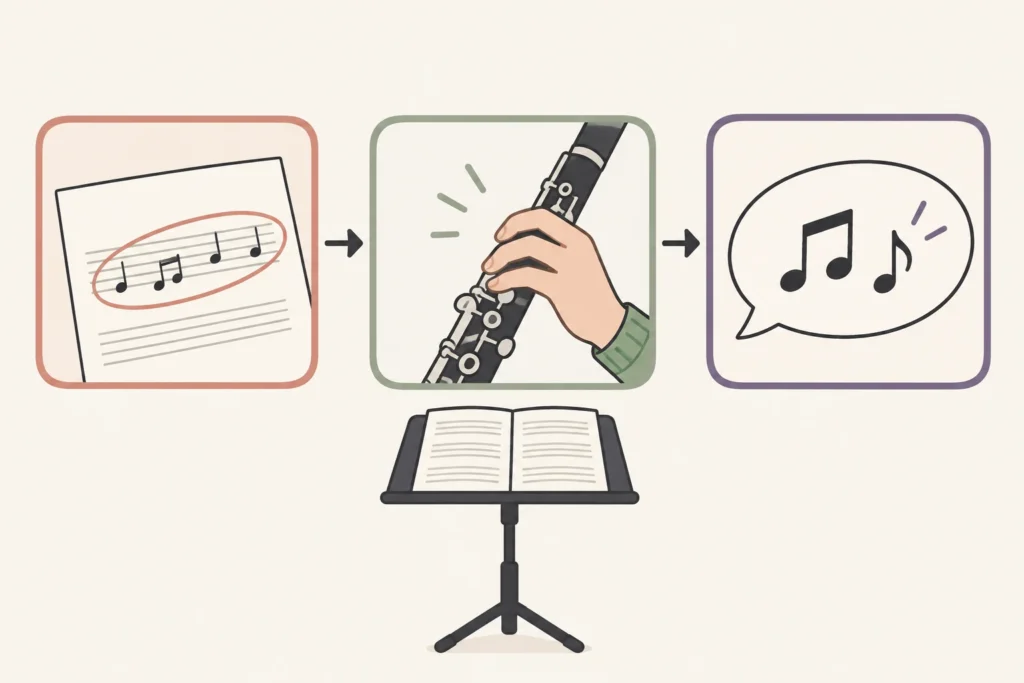
Suppose the teacher’s assignment is: “Measures 5-6: clap and count the rhythm, then play it slowly without pausing between the measures.” That gives you something specific to ask about without making up a correction. MTNA’s Practitioner Tips include a suggestion from a teacher to keep written reminders to one or two targets; this is helpful, and is not a scientifically established optimum.
Decide on an occasional check-in, then ask only one of the following:
- “Can you show me where you’re working on?”
- “Can you demonstrate how your teacher showed you to practice it?”
- “What did you change when you tried that?”
- “Which part still needs help?”
Pointing, clapping, singing, or playing part of it can answer the question. You’re not owed a full explanation or demonstration. “I can clap it but I still stop when I play it” is a good thing to hear. They know part of the task and are able to identify what’s still difficult. I’d rather hear an honest distinction like that than demand a perfect performance.
Keep this brief and agree with your child on when you’ll listen. The check-in is a practical suggestion, not a tested intervention, and the sources here don’t establish an ideal frequency. One successful demonstration doesn’t prove the learning will last, either. You’re finding out where help might be needed, not asking your child to pass a daily test.
Give the support this child needs
A young beginner may need you beside them to find the page, recall the task, and stay with the teacher-taught activity. A more independent student may need only help protecting practice time and an occasional interested listen. I’d base that difference on what the child can manage, not a birthday.
With some teaching arrangements, the goal is to take a step back. Suzuki Association guidance describes the daily shared practice with the occasional goal-oriented listen and more student choice and control in practice later on. If you’re being trained by your teacher to take on an active home role, keep that role and be that role. You should replace that home role with a brief check-in only if the situation is absolutely warranteed. Some research, in fact, indicates that responsive and cooperative parental involvement is associated with more positive student-reported learning experiences. It doesn’t suggest that either constant or very little supervision is best for children in general.
When the assignment needs a clearer explanation
If your child can do the task at hand, let them work. Children getting stuck and repeatedly asking for help is different. In this case, you can tell the teacher something like, “Joining measures 5 and 6 still doesn’t work.” This is a helpful sticking point, and not a reason to dismiss the whole session.
If your child can’t identify a solution after you’ve said “fix the rhythm,” then it’s probably time to get involved. Get a marked passage, demonstrated method, and explain to your child what to listen for prior to asking for repetitions. You don’t have to manufacture a solution yourself.
The MTNA Practitioner’s Tips also suggests asking a teacher to observe how a student practices independently. You could phrase this as, “Could you observe them once as they do the home task during the lesson? And show us where to insert help?” With the teacher's observations, you know how to aid them, and more importantly, how not to aid them.
Sources and references
- Music Education Research; author manuscript hosted by University College London: Learning a musical instrument: The case for parental support (2010)
- Music Education Research / Taylor & Francis: A Longitudinal Study of Self-regulation in Children's Musical Practice (2001)
- Music Teachers National Association: Practice
- Suzuki Association of the Americas: The Changing Role of the Suzuki Parent