
Recover where the music is going, not every note you missed. If you still know your location and timing, continue without replaying the error. If other musicians are continuing and you’re lost, listen for a confirmed upcoming entrance and join when they reach it. Playing alone, you can pause briefly and resume at a dependable landmark. I’d rather hear a clear return to the phrase than a hurried attempt to repay a debt of missing notes.
These are teaching recommendations, not a scientifically established ranking of rescue tactics. The useful choice depends on what you still know, and whether you control the musical timeline.
What, exactly, has gone missing?
If a mistake occurs, it does not mean you've lost your spot. If you know what comes after the mistake, leave it behind and don't repeat it. Repeating a wrong note slows down the pace of the music, and in the case of a group, repeating a wrong note creates an incongruence amongst the group.
Sometimes the passage is still clear but its timing has slipped: you know the notes, yet can’t tell whether the group is on beat two or three. Listen to the part carrying the pulse or watch the conductor, then place your entrance against that beat. Maintaining the count and attending to conductor cues are part of the [International Horn Society’s ensemble guidance](https://www.hornsociety.org/publications/horn-call/horn-call-archive/149-advice-for-amateurs). If the beat remains uncertain, I’d leave a gap rather than add guessed notes.[3]
If your eyes have jumped to the wrong system while your ears still recognize the phrase, search for something conspicuous. Rest? Change in texture? Rehearsal letter? An easily identifiable entrances? Searching for the missed note keeps you looking at a place the others have already left.
The more insidious problem is to recognize the tune but not know which instance you are hearing. First statement, repeat, or return after the middle section? A steady beat cannot give you an answer. Look for an ending that is different, maybe a bass line, or an instrument entrance. I would feel more confident if the score only contained one instance of the tune. I cannot feel the same way if the score contains three instances of the tune.
Who controls the next entrance?
When you play alone, you have the freedom to keep going at the next accessible passage, or stop if you get stuck rather than try to weave together unrelated fragments. You can stop, catch your breath, and remember the start of a phrase you can rely on. You can hear the tempo in your head and begin again. Of course this will disrupt the music, but you don't always have to start from the very beginning.
With an ensemble, remembering bar 13 doesn’t let you play it while everyone else is in bar 10. Keep counting if your count is intact. Otherwise, listen and look for something that identifies both the location and the entrance timing. The [International Horn Society recommends maintaining the count and giving a relevant bar number when a colleague is lost](https://www.hornsociety.org/publications/horn-call/horn-call-archive/149-advice-for-amateurs). A discreet cue can spare you a lot of searching, where the ensemble’s conventions allow it.[3]
A live accompanist may adapt, but they can’t be expected to decode an unannounced jump. [Ohio Music Teachers Association guidance](https://www.ohiomtasouthwest.org/single-post/2017/02/13/adventures-with-accompanists-finding-the-collaborative-pianist) emphasizes listening and communication in collaborative playing. I’d agree on a few recovery points beforehand, including who cues a restart if you both stop. While the accompaniment continues, its timeline is the one you need to join.[4]
A fixed backing track won't wait or follow. Rejoin where it is, or stop the performance if you can’t figure it out.
Possibly you can simplify rather than fall silent. Perhaps a pianist can retain a familiar bass pattern and drop decorative notes when the arrangement permits it. That does preserve a part that is at least familiar to the pianist. It is not really a solution for being utterly lost and I am not going to ask you to do that.
An imagined recovery at bar nine
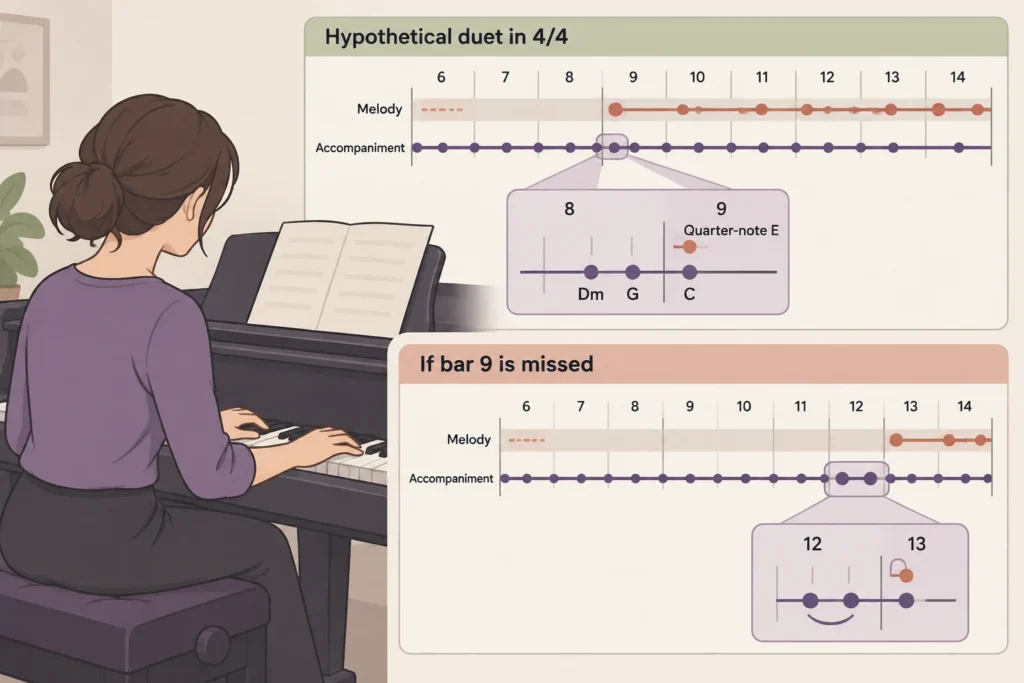
Picture me playing the melody in an imagined duet in 4/4. In bar six, my eyes jump one system down, and suddenly neither line looks right. I feel the urge to replay the phrase opening, something familiar, please, but the pianist is still moving. Instead, I leave a gap and listen for the distinctive chords leading into bar nine. That changes my task from reconstructing the past to catching an entrance.
Here, the accompaniment provides tonal and structural information that helps us understand where we are and when to come in. On beat three of bar eight, the accompaniment plays D minor, on beat four of bar eight, the accompaniment plays G major, and on beat one of bar nine the accompaniment plays C major. These three chords occur together only in this instance. We need to rely on something else to help us identify when to come in. The melody begins on beat one of bar nine with a familiar quarter note E. This is a reasonable place to come in, if you know the phrase that follows.
If you haven’t come in on bar nine, a fallback accompaniment fill occurs on bars 12, beats three and four, that leads to an entry on beat one of bar 13. You cannot jump to the remembered passage from the fallback. If either of these occurred in other instances in the song as well, we would need to know of some other distinguishing characteristic. I'm less concerned with a circled bar number than if you can hear the phrase coming and enter on the beat.
Rehearse joining, not getting frightened
Practice to identify these access points has some research grounding, though I wouldn’t base a guarantee of live performance recovery on this. [A study of one expert pianist](https://production.wordpress.uconn.edu/musiclab/wp-content/uploads/sites/290/2013/10/Practicing-Perfection-Chaffin-2002.pdf) shows structuring practice around the locations of musical cues helps in preparing performance recalls. A [study of one experienced singer’s six written recalls over five years](https://research.rncm.ac.uk/en/publications/recovery-from-memory-failure-when-recalling-a-memorized-performan/) found recall gains at structural beats carrying performance cues. Written recall is not the same as an onstage lapse. Neither study shows which tactic is the most useful for beginners.[1][2]
My adaption is to introduce a planned gap, rather than an unplanned interruption. Agree upon one passage and one recovery point and play from that point through the end of the phrase. When that entrance is playable, leave out an agreed on stretch at a comfortable tempo, while your partner or a recording continues. Listen through the gap and rejoin at the cue. When practicing alone, work on pausing and resuming at the landmark without replaying the lead-in.
To begin, the gap should be brief and predictable. The goal is to test your access and the degree of control you have over the coordination, not to see how uncomfortable you can be with a large amount of alarm. A successful planned attempt provides insight, but does not validate how well the exercise translates to an unexpected lapse.
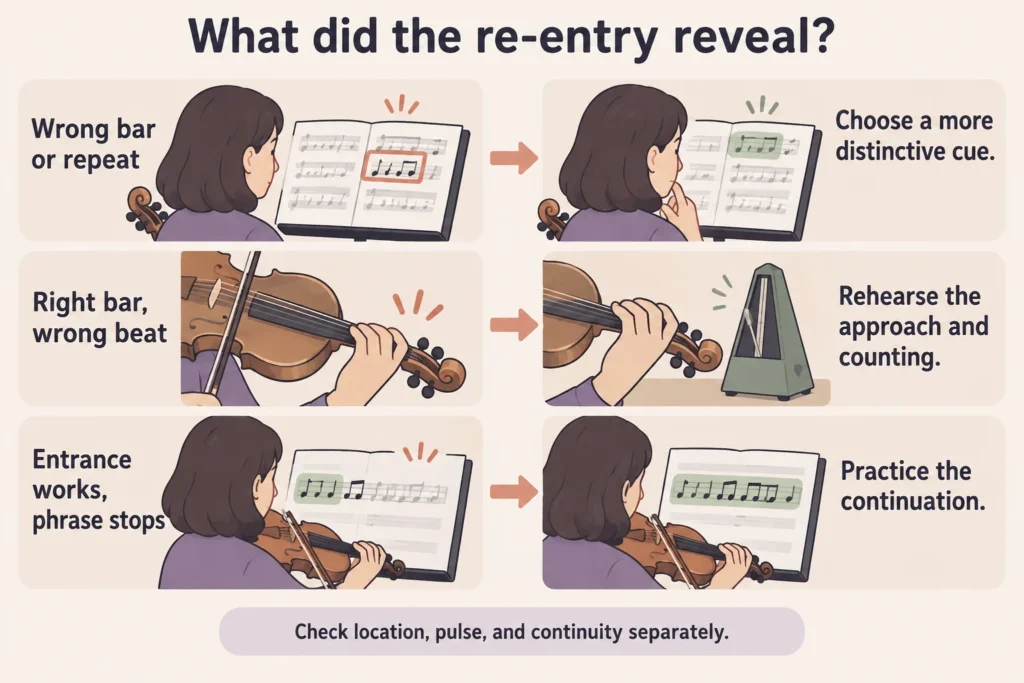
- Location: Were you able to join the bar that was intended? Were you able to identify the correct occurrence of the passage?
- Pulse: Was your entrance on the precise beat or subdivision? Did it roughly land on tempo?
- Continuity: Could you carry the following phrase without stopping or looking for it?
If there were mistakes, what needs another try? Listening to an approach and counting in is the answer for hitting the bar on time. Giving a more distinctive cue is the answer for the wrong repeat. Continuation is the answer for a blank first note followed by a second blank note. I’d keep a tiny note such as “bar nine found; entrance late; phrase continued.” It suggests what to do for the next try. Instead of repeating the whole passage and crossing your fingers, you'll actually be listening for the last two beats and planning to enter with them.
Sources and references
- Psychological Science; author copy hosted by University of Connecticut: Practicing Perfection: Piano Performance as Expert Memory (2002-07)
- Musicae Scientiae; Royal Northern College of Music research portal: Recovery from Memory Failure when Recalling a Memorized Performance: The Role of Musical Structure and Performance Cues (2023-03)
- International Horn Society: Advice for Amateurs
- Ohio Music Teachers Association, Southwest District: Adventures with Accompanists: Finding the Collaborative Pianist (2017-02-13)