
What Should I Do When I Lose My Place During a Performance?
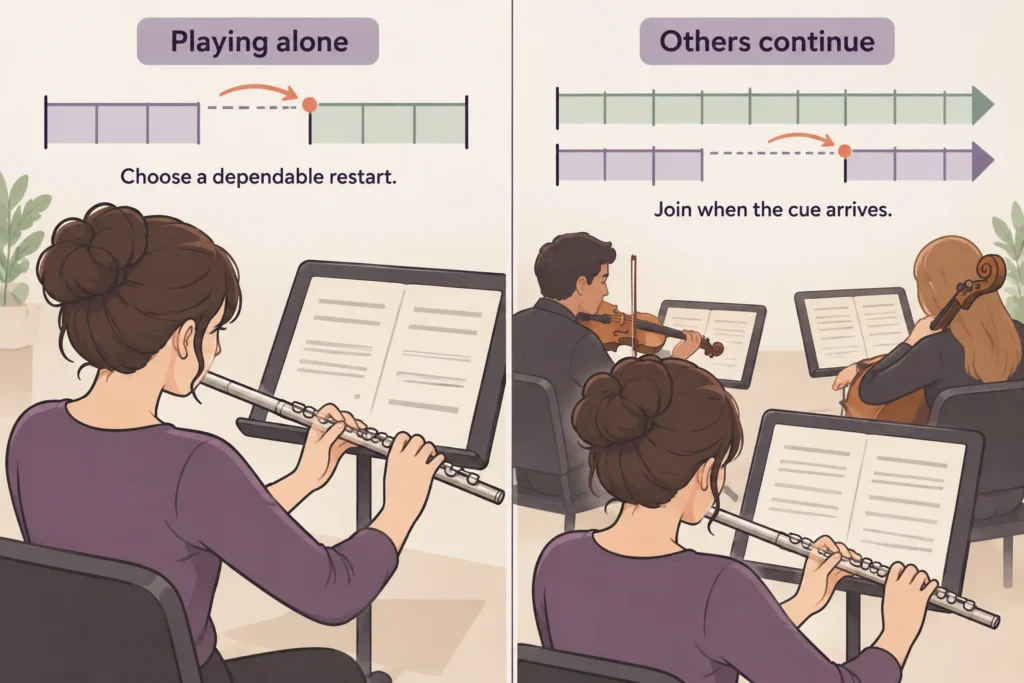
Recover your musical location and timing, not every missed note. Here’s how to choose a re-entry when you’re alone, playing with others, or following a backing track, and how to rehearse it.
How Should I Prepare a Piece When I’ll Perform It on an Unfamiliar Instrument?
Choose a few passages that reveal the responses your piece needs, then use your arrival trial to make small, audible adjustments, not rebuild your technique.
Messy Practice, Messy Performance: The Chaos You’re Bringing Into Every Song
If your practice sessions are scattered, your performances will be too. Learn how “messy practice” creates timing issues, memory slips, shaky transitions, and inconsistent tone—and use a simple, repeatable framework to “
Memorization vs Reading: How to Practice So Pieces Don’t Fall Apart Under Pressure
Memorizing can feel risky, and reading can feel safe—until pressure hits and you lose your place anyway. This guide shows how to practice with a “prove it” mindset (retrieval, landmarks, random starts, and pressure reps)
The Confidence Trap: Why Feeling Good in Practice Can Be a Warning Sign
Sometimes the smoothest practice sessions create the weakest real-world performance. Learn why “feels easy” can signal shallow learning, how to spot false confidence, and how to redesign practice so your confidence is *e
How Performance Anxiety Quietly Changes Technique Before Musicians Even Notice
Performance anxiety does not usually start with the obvious mistake. It often starts earlier, with small shifts in breath, force, tempo, and attention. This article explains how to catch those shifts early, use the SILEN
How to Know When a Piece Is Actually Ready to Perform

A piece is not performance-ready because it worked once in practice. This article gives you a practical way to judge real readiness, test weak spots under pressure, and decide whether your piece is ready for a recital, a
Messy Practice Creates Messy Performances: The Connection Most Players Ignore
If your performance looks chaotic, your practice environment might be teaching chaos—without you realizing it. Learn how to tell the difference between sloppy reps and purposefully “messy” training that improves real, in
Why Musicians Sound Better Alone Than They Do in Front of Other People
Many musicians do their best work alone and then feel their playing shrink the moment someone listens. The gap is usually not a talent problem. It is a mix of social pressure, attention overload, and practice that never
The Memory Practice Mistake That Makes Reliable Pieces Fall Apart on Stage
When a piece collapses after one small blank, the problem is often not a lack of work. It is a memory method that teaches continuation from the beginning instead of retrieval, restart, and recovery under pressure.