
I’d favor several workable opportunities to revisit the same music over saving everything for one long session. But I wouldn’t turn that preference into a seven-days-a-week requirement. Short visits suit returning to a passage after a break; longer appointments give you room to connect sections and rehearse a complete performance. A mix can serve you better than either extreme.
This is an evidence-based recommendation, not a strict formula based on research involving adults. Research gives us multiple reasons to be in favor of spacing, but it doesn’t necessarily mean constant practice is always worse. The important question to ask is what you can still play when you return, as opposed to how nicely your practice calendar looks.[1][2][3][4]
The same 90 minutes can do different jobs
Suppose you have 90 minutes available each week. These are illustrations, not prescriptions, and the time includes whatever setup and breaks your instrument needs.
| Schedule | What it makes room for | What can get squeezed |
|---|---|---|
| Monday through Saturday: 15 minutes each | Frequent returns to a small target, if you actually revisit it | Setup consumes more of each visit; complete-piece work may not fit |
| Tuesday and Saturday: 45 minutes each | Passage repair followed by connecting sections and playing through | Only two starting attempts after a break, with longer gaps between visits |
| Tuesday, Thursday, Friday: 10 minutes each; Saturday: 60 minutes | Brief target revisits plus one substantial appointment for integration | Short visits need a narrow task; the long appointment may need breaks |
In the end, all things being equal, six visits doesn’t mean the same thing as two long visits, and six days of practice isn’t the same as playing the same music six times.
Imagine I’m at the piano on Tuesday evening with 15 minutes before dinner. Five go to deciding what to play, and I start at page one because it’s familiar. Then dinner’s ready just as I reach the troublesome transition. Oh, good, another rehearsal of the part that already works. I’d leave the score open at that transition for the next short visit and save the whole-piece work for Saturday.
What the music studies actually tell us
Some questions asked vary from experiment to experiment. In Simmons’s keyboard study, 29 non-pianist musicians learned a nine-note sequence across three sessions separated by five minutes, six hours, or 24 hours. Significant accuracy improvement in Session 2 appeared only in the 24-hour group. This does support taking the interval between the sessions seriously, but is not a case in support of the improvement being due to superior retention after a common, separate, long delay.[1]
A 2017 novice-piano experiment found no spacing advantage when gaps ranged from zero to 15 minutes and retention was checked after five minutes. I wouldn’t say the results of that study showed spacing is essentially worthless. They simply showed no benefit of spacing for very short gaps and a short delay between practice sessions.[2]
A 2025 study provides more information. Of 90 participants, spacing with an interval of 2 days or 1 week resulted in better sung recall of the melody than massed learning over a delayed 3 week test period. No benefit was shown for one spacing interval over the other. But participants averaged about 20 years old, and 52 failed the initial learning criterion. This means that participants who reached that criterion and were able to demonstrate sung recall of the melody are not necessarily equivalent to adult beginners trying to coordinate both hands on the piano.[3]
I don’t think the results of these studies indicate that spacing should always be done. I think they indicate that a piece should be reviewed, and perhaps even practiced on a daily basis. The same distinction is made in a broader narrative review of skill learning. They state that the results of various studies describe tasks that require different intervals in order to be remembered. Likewise, the review does not offer an explanation as to what the best spacing interval would be.[1][2][3][4]
Give short visits a target, and long visits a purpose
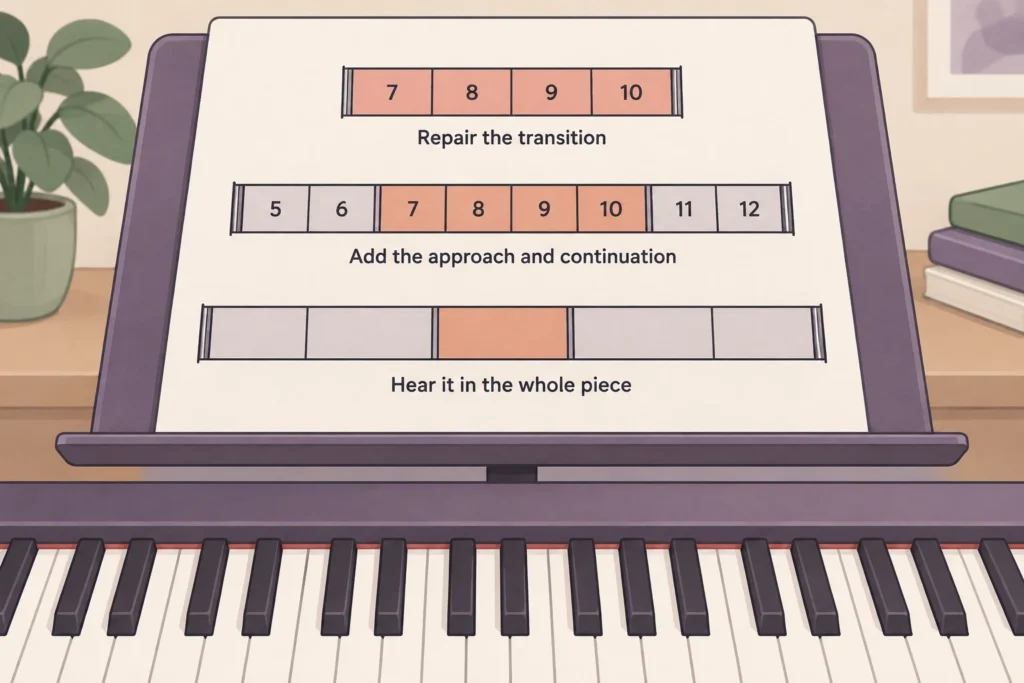
Take a four-bar piano passage where a left-hand chord change interrupts the melody. Your target might be playing bars 7-10 at a comfortable fixed tempo, landing the chord correctly without pausing at the bar line. A brief visit can address that passage, demonstrate arrival of the chord change, and play through the transition. This is more specific than "10 minutes of piano."
A limit is necessary. If a decoding of every note is still needed and a firm fingering is not established, that brief visit may not serve its purpose and end before the passage is playable. I think an extended visit is more appropriate for that early work, and then use shorter return visits when something playable exists. This is a practical approach to learning a difficult passage, and not a proven law that all difficult tasks require longer sessions. University music learning guidance supports the use of smaller targets and practice subdivided into shorter visits, but it does not necessarily support this weekly practice.[5]
When the transition is learnt to play alone, longer practice sessions may serve the purpose to address the preceding phrase and reach the next. Continuous play through the whole piece is also practiced. Don't repeat a four bar passage just because it was Tuesday's problem. When attention or focus starts slipping, take a break. The calendar is not the boss.
Listen to what survives the break
The last run is worthwhile, and it asks a different question than your first attempt after a break. The first asks, “What remains available when I return?” The last asks, “What could I do after working on the passage?” In your next return, take any warm ups you need, and try the bars once before repeating. Keep tempo, score access, and starting position the same. I’d rather you use a short recording to help this time, rather than have you turn this into another logging assignment.[2][4]
You can listen for accuracy and continuity separately. Did the melody arrive with the correct written rhythm, and the chord arrive with the correct pulse? Did the pulse continue uninterrupted? If there are pauses, correct notes after the pause aren’t a continuos flowing phrase. If you’re attempt is flowing, but there are incorrect chords, the accuracy isn’t solved.
You can only compare your schedules so many times before the next visit becomes tomorrow or 4 days later. You might occasionally check after a delay of 48 hours. However, this is an example, not an optimal interval. There could be differences due to passage difficulty, the learning you’ve accumulated, how much energy you have, and the feedback you get. All these factors can inform where you should focus your time, but they can't help you determine which is the best schedule.[2][4]
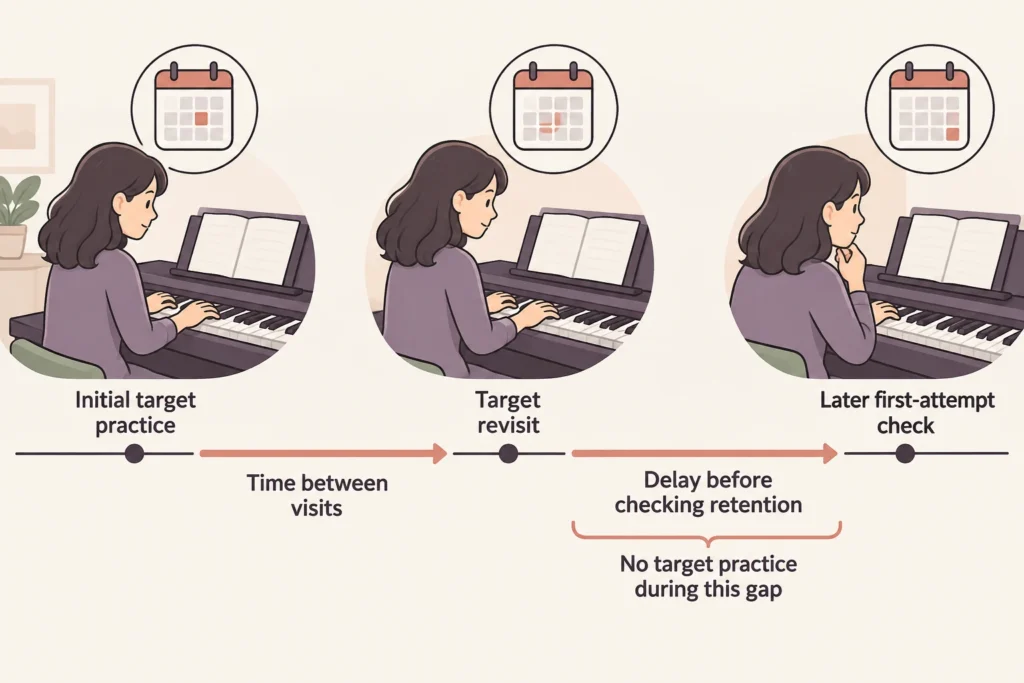
If you need to rebuild a lot at the beginning of each visit, try spending a little more time on a short return to that passage. If the passage is isolated and complete but the surrounding passages aren't, try protecting a longer time for connecting and playing through the piece. I would choose the schedule that leaves you feeling more in control and able to play continuously for longer periods over a schedule with more rest days.
Sources and references
- Journal of Research in Music Education / Sage: Simmons, Distributed Practice and Procedural Memory Consolidation in Musicians’ Skill Learning (2011-11-15)
- PLOS ONE: Wiseheart, D’Souza, and Chae, Lack of spacing effects during piano learning (2017-08-11)
- Psychology of Music / Sage: Katz and Wiseheart, Spaced learning and melodic memory (2025-12-30)
- Frontiers in Psychology: Smith and Scarf, Spacing Repetitions Over Long Timescales: A Review and a Reconsolidation Explanation (2017-06-20)
- University of Texas at Austin, Center for Music Learning: Duke and Simmons, Tips for Efficient, Effective, Joyful Practice