
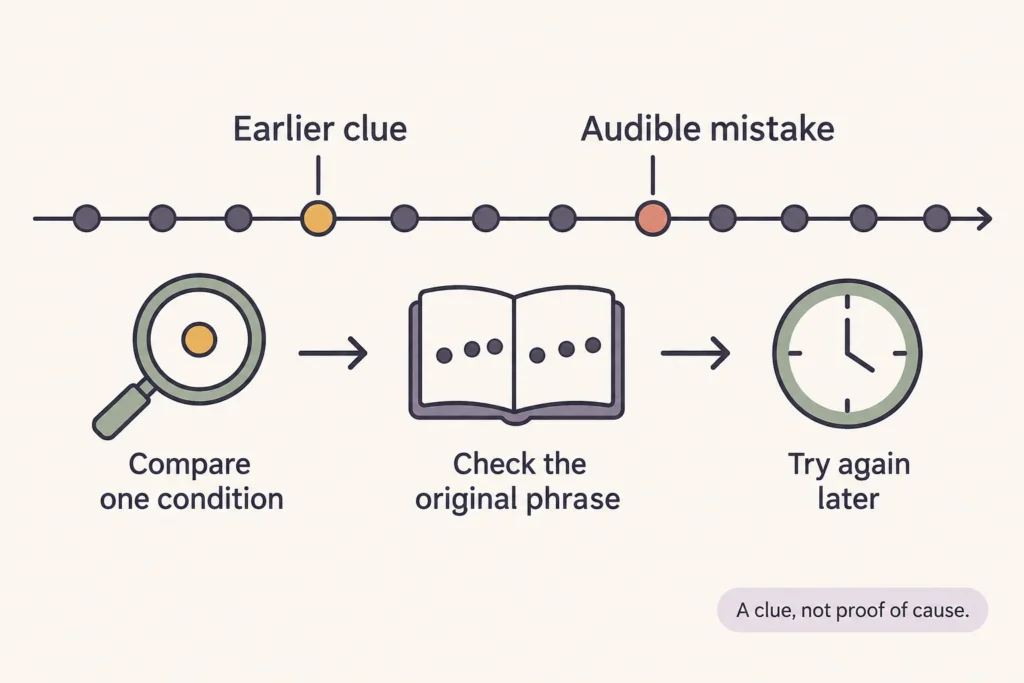
When searching for the cause of an intonation problem, listen for the passage’s first problem, not the passage’s last. Test an explanation and hear if it’s wrong. You may hear the wrong note long after the problem started. It may be caused by an accidental, a rushed duration, an awkward movement, or a transition that was not prepared. I’d rather ask a question specific to the problem instead of having you repeat the passage.
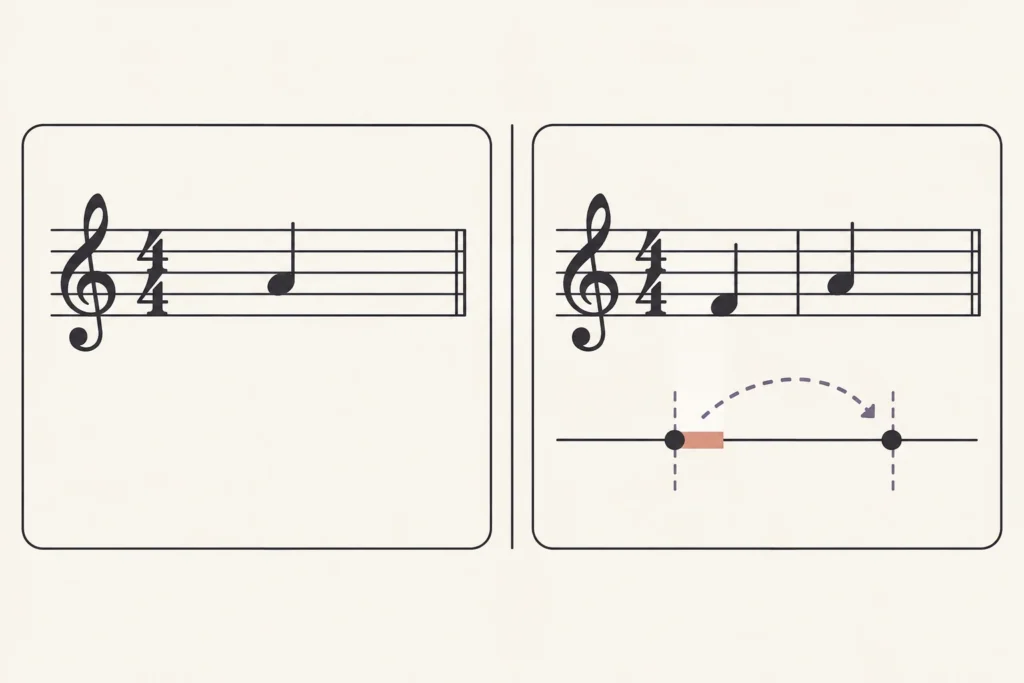
Picture me, in an imagined evening practice session, with ten minutes left and a higher C that keeps arriving late. I start directly on C, play it cleanly, and feel briefly vindicated, until I reconnect the preceding G. There’s the delay again. Rather than spend my remaining minutes polishing C, I change the question: what happens while I’m leaving G?
Look just before the mistake
Practice a stretch of passage that includes the problem and the approach, or the problem and the exit, at a tempo that makes the issue appear. Listen for the first example of the problem. It may be an uneven duration, or a pause. You may feel uncertain about the preparation of the note. Listen for the first example of the problem.
In the G-to-C example, if G is a quarter note on beat 4 and a higher C is on the following downbeat, you would interpret the C as late. But the recording also suggests that G is ended earlier than you intended. Mark the G as shortened and the C as late, and don't consider the C as being late because of the G is shortened. Both could suggest difficulty in moving to the C.
Recordings can provide information better than “that went wrong” again. In a study of 32 instrumentalists, participants who listened to recordings of themselves identified more inconsistencies the second time around after reflecting on their performance. The extra time and recording helped them identify more inconsistencies. You can use a recording to decide what to investigate. You can’t use it to definitely state a cause.[4]
Choose the comparison that fits your clue
Choose the comparison that supports what you noticed the most. You can change one variable at a time, keeping other things as similar as possible. Easier versions of a test (like a metronome set slower) may address several problems at once. These are exploratory tests, and you can be confident a change is in the right direction even if you don’t know exactly why.
If the score itself feels uncertain
Take the instrument out of the task briefly. Point to the notes and name the pitches, including accidentals. Suppose an F-sharp earlier in the measure applies to another F in the same octave, but you keep playing that second F natural. If you also name it incorrectly, clarify the notation before drilling the movement. Marking the repeated F-sharp may be more useful than slowing down an incorrectly understood note.
If you name it correctly without hesitation but still miss it while playing, I’d investigate execution or reading under playing demands next. Accurate naming shows that you can interpret those pitches in this simpler condition. It doesn’t show that you can read ahead while coordinating the instrument.
If the arrival is early or late
Speak or tap the written rhythm at the same beat rate. For a dotted eighth followed by a sixteenth, then a quarter note, count “1 e & a 2.” The attacks fall on “1,” “a,” and “2,” not on “1,” “&,” and “2.” If the short note lands on “&” even when you tap, work on hearing and placing that final subdivision before adding the pitches.
Timing is also available without the demands of the production, so it is best to examine the written rhythms and make proportional statements about them rather than to assume that every intentional slight adjustment is an error.
When the movement catches
In the right hand, when ascending C, D, E, F, G, fingering is 1-2, 3-1, 2, thumb crossing between E and F. If the F arrives late, try again at a lower tempo. If the result is clean, arriving on time is the issue, not preparation, coordination, or reading speed. I would not blame a “weak” finger with that evidence.
A different fingering is worth trying when you can name the conflict: perhaps the current choice leaves your hand poorly placed for the next note. Compare an alternative at the same tempo, including the approach, arrival, and exit. If it frees F but makes the following notes awkward, you’ve moved the snag, not solved it. If both choices work slowly but fail faster, I’d investigate preparation and coordination before changing fingering again. The useful choice depends on your instrument, your hand, and what follows, not just these five notes.
When isolation hides the problem, keep the approach
Return to G and the higher C. Compare starting directly on C with starting on the preceding G, keeping the tempo and C’s fingering unchanged. If only the approach fails, more isolated Cs leave the relevant demand untested. Keep G-to-C in the repair, including enough of the phrase to reproduce the troublesome setup. A string crossing or a breath before an entry can make the approach just as important on another instrument.
If C also fails from a direct start, then the transition isn't the entire explanation; go back to pitch/rhythm knowledge/execution. This is why I prefer the smallest useful simplification, not the smallest fragment automatically. University of Texas practice guidance also recommends changing a difficult task as little as possible while retaining its final performance characteristic. That’s more of an educational suggestion than proof of the cases provided here.[2]
Let the repair earn your trust
A repair has a job to do; play the original notes, correct rhythm and articulation, and correct spot/phrase coordination and tempo. And enter from a spot farther back in the phrase. Listen for both the earlier clue and the audible mistake. If a longer, less local, version of the repair is needed for the maintenance job, it should be added to your practice. More clean, isolated notes, won’t answer the question you have.
There is also a less kind, but useful, check. After your normal warm-up, do the spot a few times without doing the others. A review of learning has distinguished immediate, practice performance, from retention and transfer. That evidence is for motor skills as well as verbal skills, and not this particular repair; it helps to answer if the improvement holds, not state how many musical practices or what an exact waiting period is.[3]
There’s a small music study worth remembering. 17 advanced pianists were learning a three-measure excerpt. The three highest ranked next-day performers identified and corrected error sources, and varied tempo systematically to check for stability. There was no evidence to show that these behaviors actually caused the memory retention, and I don’t recommend this approach to dealing with memory issues, but rather take this as evidence that paying attention to error responses is probably worthwhile.[1]
I’d rather you keep a tiny note that says “direct C clean; G to C late; next session, phrase entrance clean” as opposed to noting x number of repetitions. A repetition total gives you no idea if the error was actually addressed or not; a repair should be able to withstand the demands of the music as well as other related relevant entrances. I’d also trust that the repair was addressed if a later first attempt was made, and a private rehearsal of C was not made first.
Sources and references
- Journal of Research in Music Education; Duke, Simmons, and Cash: It's Not How Much; It's How: Characteristics of Practice Behavior and Retention of Performance Skills (2009-01)
- University of Texas at Austin, Center for Music Learning: Tips for Effective Practice
- Perspectives on Psychological Science; Soderstrom and Bjork: Learning Versus Performance: An Integrative Review (2015)
- Update: Applications of Research in Music Education; Palese and Duke: Thinking Time in Music Practice (2022)