
If a passage continually breaks down, it will feel like your hands are being controlled by someone other than you; going from dependable at a moderate pace one day, to extremely stiff, fast and/or not being able to land on the correct finger the next day. You typically will end up hitting this passage more times with more force because with every little jolt of stress on each of those repetitions, you have not only taught your fingers the notes but you are also teaching your fingers about that little jolt.
The goal is not to make practice feel easy. The goal is to make the target clear enough that your nervous system can store a usable movement pattern. That means smaller chunks, cleaner entries, slower speed increases, and a deliberate way to stop before tension becomes the lesson. Research on motor learning suggests repetition can strengthen the movement you actually perform, not only the ideal movement you meant to perform, and sequence learning tends to organize itself into chunks over time. (pmc.ncbi.nlm.nih.gov)
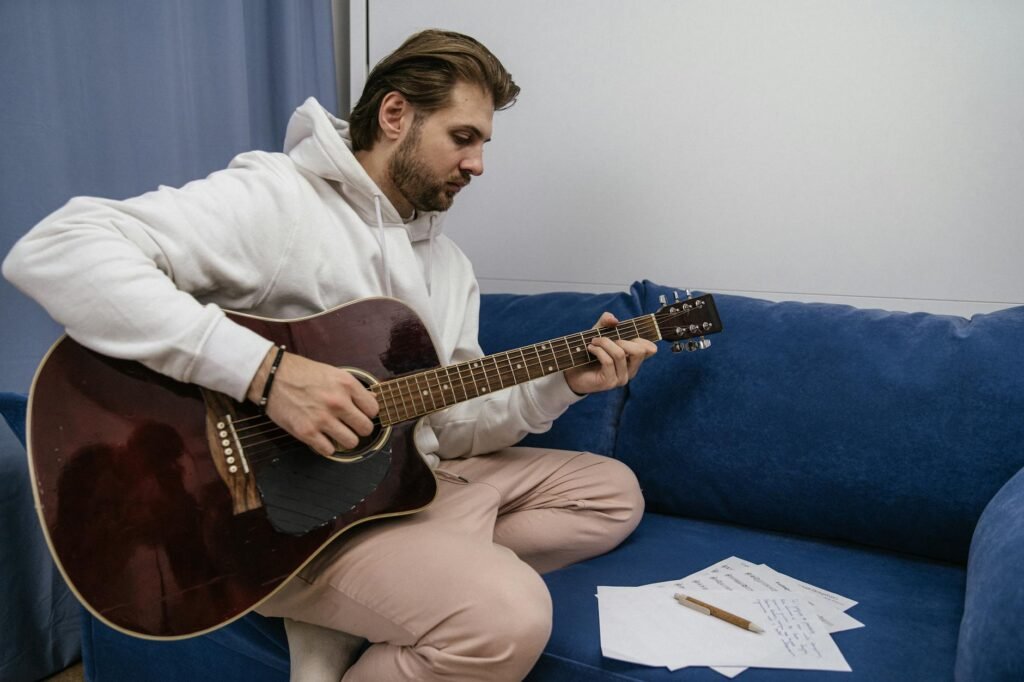
- If a difficult rep starts with tension, speeds up, and ends in a scramble, you may be rehearsing the panic pattern rather than the passage.
- Use the PACE Gate below before you raise tempo: Prepare, Accuracy, Calm, Exit.
- Work in tiny overlapping chunks first. Stable chunking helps performance, but forcing speed too early can lock in a flawed pattern. (pmc.ncbi.nlm.nih.gov)
- Once the passage is mostly secure, add variation and low-stakes performance reps. Interleaved practice and repeated exposure can improve transfer better than endless blocked drilling. (pmc.ncbi.nlm.nih.gov)
- If the passage causes pain, tingling, numbness, or escalating panic, stop treating it as a discipline problem and get help from a qualified teacher or health professional.
Why brute-force repetition can backfire
When players say their hands panic, they usually mean some mix of threat-focused attention, excess muscle tension, reduced fine control, and a fast urge to escape the spot that feels dangerous. Music performance anxiety research describes many of those same physical signs, including increased tension and reduced motor control. That does not mean every hard passage is a clinical anxiety issue. It does mean the body can start treating a familiar musical spot as a threat cue if practice has repeatedly paired that spot with failure and urgency. (pmc.ncbi.nlm.nih.gov)
Motor learning also has a plain mechanical side. If you repeat a movement with extra force, late preparation, and a rushed correction, repetition itself can bias later movement behavior in that direction. Meanwhile, sequence learning tends to form chunks, and speed pressure can favor chunking that gets you faster at the cost of more errors. In practical terms, if you always practice the passage as one alarming blur, your hands may become very good at reproducing the blur. (pmc.ncbi.nlm.nih.gov)
Use the PACE Gate before you add speed
You do not get to move up in tempo just because an individual rep passed the test, you get to move up when the rep was executed in a consistent, relaxed, and repeatable manner. You should keep a score of either “pass” or “fail” for each of the 4 items. Only after you have successfully executed 4 out of 4 items twice in a row will you be able to increase your tempo.
| Gate | Question | Pass standard | If it fails |
|---|---|---|---|
| Prepare | Did the hand shape, fingering, and contact point get set before the entrance? | You can pause, set, and enter without a grab. | Start earlier, add silent setup, or shrink the chunk. |
| Accuracy | Were the notes, rhythm, and fingering correct enough to trust? | No mystery misses and no lucky saves. | Slow down or cut the excerpt to fewer notes. |
| Calm | Did the forearm, wrist, jaw, and shoulders stay reasonably loose? | No obvious clench, jab, or held breath. | Reset, exhale, and reduce speed or force. |
| Exit | Could you continue one or two beats past the hard spot without collapsing? | The landing after the danger point is stable. | Practice the note after the problem, not only the problem itself. |
That last gate matters more than many players think. A passage often feels broken at note seven, but the actual defect is that the body has never learned how to land note eight and continue. Reliable playing depends on linking movements into stable chunks, not surviving isolated notes one at a time. (pmc.ncbi.nlm.nih.gov)
Build the passage in pieces your hands can keep
At first, many difficult sections appear to be too big. Instead of starting from the first incorrect note, you should begin a bar or two ahead of the note and go to the next bar or two after. Create an overlap of the sections. For example, play from note 5 to note 8 in section A, then on section B from note 7 to note 10. Overlap will help the brain/(body) not interpret each of the sections as separate and independent (through the use of edges/borders) but they are one in the same (continuity). Transitions are where fear and therefore, panic occur.
- Mark the collapse point. Circle the exact note or shift where the body speeds up, stiffens, or guesses.
- Back up one beat or two notes. Your practice entry should include the approach, not only the impact point.
- Cut the passage to the smallest chunk that can still sound musical enough to organize. For many players, that is 3 to 7 notes.
- Set silently before each rep. Shape the hand, hear the sound internally, and release the shoulders and jaw.
- Exhale gently before the entrance. The purpose is not deep relaxation. It is to interrupt the grab-and-go reflex.
- Play one rep only. Then stop and score it with PACE.
- If you pass 4 out of 4 twice in a row, raise tempo by 2 to 4 bpm. If you fail twice, drop 6 to 8 bpm or cut the chunk smaller.
- Finish the session with calm wins, not with an exhausted max-speed attempt.
A realistic 20-minute example
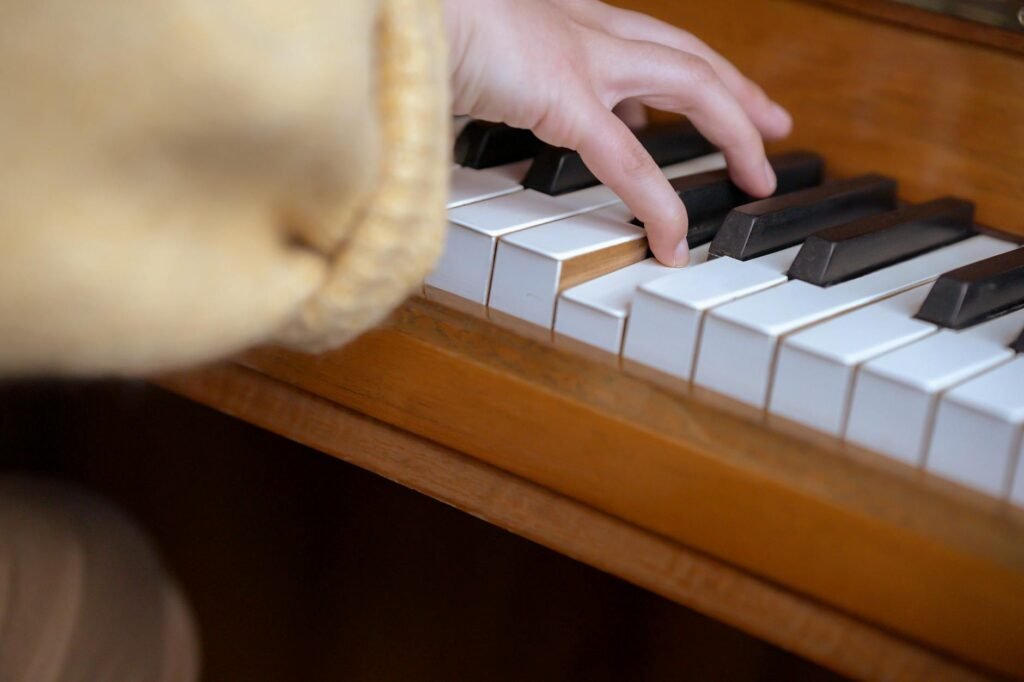
Example of a composite: A pianist has two beats to run into a left-hand leap. They want to perform at a tempo of quarter note = 126. When running the piece they tend to rush the middle of the run with their right hand, their wrist tenses up prior to the leap, and they cut off the note following the leap. Instead of drilling the entire bar, the pianist is isolating 4 notes prior to the leap and 2 following the leap. Starting tempo is 72.
Minute 1 through six: two six-note overlapping chunks at 72 -84 bm, each player must do 2 X 4/4 PACE first to be able to increase. Minute 7 through twelve: same as chunks above, but between 88 – 96 bm includes three landings where the only things to do are to leap and play the first note of the three that have been completed following a leap. Minute 13 through 16: same passage as 1 to 12 except 2-beat long from 96 – 104 bm; at 108 bm The Calm and Exit fails twice, player returns to 100 bm. Minute 17 through 20: three cold starts at 100, once mentally removed from the key board, two complete calm reps at 104.
Notice what did not happen. There was no heroic attempt to drag the passage to 126 by force. The session ended below top speed, but with a cleaner entry pattern, a more trustworthy landing, and far less rehearsal of the panic response. Mental rehearsal can support timing and anticipation without adding physical wear, which makes it useful between physical reps or on tired days. (pmc.ncbi.nlm.nih.gov)
Decision table: when the passage breaks, choose the next move
| What happens | Usually means | Best next move | What not to do |
|---|---|---|---|
| You rush the first note of the hard spot | The entry is underprepared | Start earlier, set silently, and practice the approach beat | Restart at the exact crash point at full speed |
| The notes are almost right but the hand locks | You are using force to buy control | Halve the chunk and practice the landing note with less attack | Lift the fingers higher or hit harder |
| Hands separate are fine; together they collapse | The timing map is unclear | Count aloud, clap the rhythm, then use tiny hands-together overlap cells | Keep piling on separate-hands reps only |
| It works in practice but fails in a run-through | You built acquisition, not transfer | Add cold starts, one-take recordings, and varied starting points | Wait until performance week to simulate pressure |
| You feel pain, tingling, or numbness | This may be a technique or injury issue | Stop and get expert help | Practice through it |
When slow practice is not enough
Although it may seem that slowing down your practice will allow you to learn music more carefully and consistently than playing quickly, many players find its not actually true. You may not necessarily have a problem with the tempo of your music, but rather you might be playing with the wrong fingerings, hand positions and/or arm positions when you are getting too high for example; also, there is the possibility of changing your bowing direction partway through which means that there could have potentially been a problem in either how you visually memorized the leap or how your ear is hearing the rhythm. Therefore, by merely taking longer doing the wrong things instead of finding out if a passage is actually stable at a speed that you can control means that you likely need to revise the way the passage was designed before determining whether you are deficient.
- If the fingering keeps changing, write it in and commit to it for one week.
- If the rhythm is vague, speak it or clap it before touching the instrument.
- If the leap is the issue, practice the arrival note first, then the departure, then connect them.
- If the body still braces even at slow speed, reduce physical reps and add mental reps. Music imagery research suggests purposeful mental rehearsal can improve timing and reduce errors, though it is usually not a full replacement for physical practice. (pmc.ncbi.nlm.nih.gov)
- If symptoms include pain, numbness, or loss of strength, stop and seek qualified help.
Add pressure only after the passage has a floor
A passage is not performance-ready when it works only after ten warm-up tries from the same starting point. Once the mechanics are mostly dependable, you need transfer practice. Motor learning research on contextual interference finds that more varied or interleaved practice often feels worse in the moment but can improve later retention and transfer. For musicians specifically, repeated stage exposure has been associated with lower anxiety and fewer technical errors across successive performances. (pmc.ncbi.nlm.nih.gov)
- Play the passage once, cold, after a short break.
- Start from three different entry points in the piece.
- Record one take only and keep going instead of correcting midstream.
- Drop the passage into a longer phrase so the exit has context.
- Play it for one other person, even over a video call.
- On the next day, test it before doing any repair work.
Common mistakes that quietly teach panic
- Starting exactly on the scary note instead of practicing the approach.
- Counting a lucky rep as proof that the passage is learned.
- Raising tempo after one success instead of requiring repeated calm passes.
- Practicing only the middle and never the exit.
- Using more force to feel safe.
- Doing so many failed reps that fatigue becomes part of the pattern.
- Leaving pressure practice for the final week.
- Confusing discomfort with productive challenge. Productive challenge is specific and recoverable. Panic practice is noisy, vague, and hard to repeat.
How to verify that the method is working
Evaluate the technique based solely on how much more you now feel inspired compared to when you initially learned it; measure results over seven days using some quantitative values. The goal is to check if this new type of emotional equilibrium from becoming calmer has increased or the quality of the experience only once when you did this exercise initially.
- Track your highest stable tempo, defined as the fastest tempo where you can earn two straight 4 out of 4 PACE scores.
- Track calm-clean rate, which is clean reps divided by total reps, but count a rep as clean only if Calm also passed.
- Track next-day cold-start success. Before warming up, try the passage once at the previous day’s stable tempo.
- Track recovery time after a miss. If one miss ruins the next six reps, the passage is still too fragile.
- If the numbers stall for a week, change something structural: fingering, chunk size, entry point, or pressure routine.
The best indication is not simply whether or not your maximum speed will increase. Rather, it is a much better indication if the next level does not feel as intense as it used to do. Your body will handle the anticipation of the next rep better, the end point will not be a shock, and you will no longer be sensitive to any one missed repetition causing emotional reactions. All of these changes represent how you are continuing to develop your hands out of a panic response.
The bottom line
When you quit looking for a complete speed miracle and begin requesting doable control, difficult parts of passages tend to improve. You may want to reduce the size of a section. Work on entrance & exit then use PACE Gate before you reward speed; afterwards increase transfer/pressure gradually. Your hands can’t take any more drama; they require more precise directions.
FAQ
Should I slow down until the passage feels almost too easy?
The answer is usually yes; however, if you can grab, rush or guess when a new item is presented, there’s not yet been enough time for the tempo of the new item to trigger an instruction/learning event. In terms of what constitutes a slow tempo, it would take enough time for you to prepare to make the movement and hear the target/account of what was just done by passing all 4 items back to back (PACE) twice.
How many clean reps should I get before I raise the metronome?
According to the guideline, two straight 4 out of 4 PACE discharges and then statistically increased by 2-4 bpm range will equal zero unless they account for lucky repetitions or being in the body’s chase mode.
Is hands-separate practice enough for a passage that falls apart hands together?
Hand-separate practice may help with finger positioning and mastering sounds in almost all cases. If coordination is the principal issue, you will ultimately need small hands-together segments (with overlap). Otherwise you will continue to improve two easier processes instead of one truly difficult process.
What if the passage only falls apart in performance, not in the practice room?
That usually points to a transfer problem, not just a note problem. Varied practice, cold starts, recordings, and mock performances matter because skills that look solid in blocked practice may not transfer as well under changing conditions. Repeated performance exposure has also been linked with lower music performance anxiety and fewer technical errors in at least some studies. (pmc.ncbi.nlm.nih.gov)
Can mental practice replace physical reps on days when my hands feel overworked?
It can help, but it is usually best used as a supplement rather than a total replacement. Reviews and studies on musical imagery suggest purposeful mental rehearsal can support timing, anticipation, and error reduction while lowering physical load. (pmc.ncbi.nlm.nih.gov)
How do I know whether this is normal difficulty or a bigger problem?
Improvement happens when you lower the size of the chunk, make the setup clearer, take your time with your progression. The bigger the problem, the less stable it will be at slower tempos, soreness/numbness occurs, and you may start to panic and cannot get better no matter how much you practice using better designed practices. A great way to help with these things is by using a skilled teacher/clinically trained therapist.
References
- Multiple Motor Learning Processes in Humans: Defining Their Neurophysiological Bases – https://pmc.ncbi.nlm.nih.gov/articles/PMC8151555/
- The Role of Strategies in Motor Learning – https://pmc.ncbi.nlm.nih.gov/articles/PMC4330992/
- Motor Skill Learning Between Selection and Execution – https://pmc.ncbi.nlm.nih.gov/articles/PMC5617110/
- Chunking as a Rational Solution to the Speed-Accuracy Trade-Off in a Serial Reaction Time Task – https://pmc.ncbi.nlm.nih.gov/articles/PMC10175304/
- The Effect of Contextual Interference on Transfer in Motor Learning: A Systematic Review and Meta-Analysis – https://pmc.ncbi.nlm.nih.gov/articles/PMC11349744/
- Repeated Stage Exposure Reduces Music Performance Anxiety – https://pmc.ncbi.nlm.nih.gov/articles/PMC10067860/
- Mental Control in Musical Imagery: A Dual Component Model – https://pmc.ncbi.nlm.nih.gov/articles/PMC6712095/
- Mental Practice Promotes Motor Anticipation: Evidence From Skilled Music Performance – https://pmc.ncbi.nlm.nih.gov/articles/PMC3747442/
- It’s Not a Virus! Reconceptualizing and De-Pathologizing Music Performance Anxiety – https://pmc.ncbi.nlm.nih.gov/articles/PMC10667921/
- What Can Studying Musicians Tell Us About Motor Control of the Hand? – https://pmc.ncbi.nlm.nih.gov/articles/PMC2100211/