
When Should I Use a Metronome, and When Should I Practice Without One?
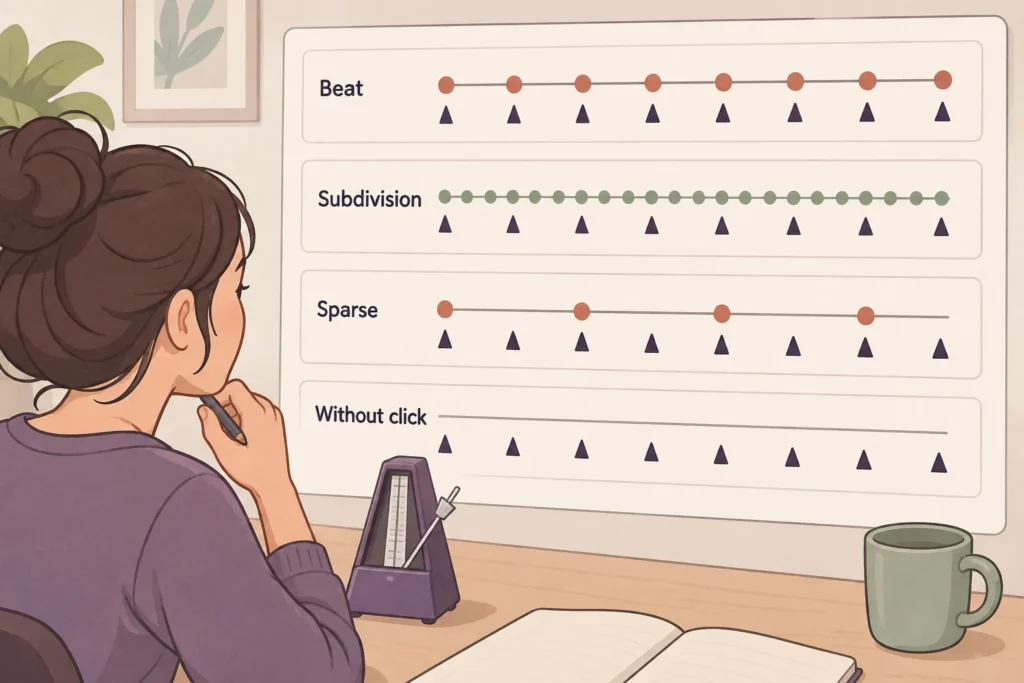
Beat clicks, subdivision clicks, and sparse clicks answer different timing questions. Here’s how to choose useful support, and hear what survives when you remove it.
Fixing Uneven Finger Strength: A 7-Day Drill for Weak Ring and Pinky Fingers
A practical 7-day plan to improve ring- and pinky-finger strength, control, and endurance using tendon glides, finger isolation drills, and light resistance (rubber band or putty)—plus clear red flags for when weakness/n
The Hidden Timing Habit That Makes Good Musicians Sound Unpolished

A lot of strong players do not actually lose tempo. They borrow time from easy notes to pay for hard motions, then rush to give it back. That tiny trade is one of the fastest ways to sound less polished than your skill,,
The Tempo Ceiling Problem That Stops Musicians From Playing Fast Passages Cleanly
A practical diagnosis-and-repair guide for the point where fast passages stop being clean.
How to Practice Scales With a Metronome When Your Timing Collapses Above 80 BPM
If your scale practice falls apart above 80 BPM, you don’t need more willpower—you need a better tempo strategy. This guide shows how to diagnose what “80 BPM” really means, set the metronome up to support internal time,
Why You Play Perfectly Slow but Fall Apart Fast: The Tempo-Gap Practice Method
If you can play a passage flawlessly at a slow tempo but it collapses when you speed up, you’re not “bad at tempo”—you’re practicing in a way that doesn’t train the fast version of the skill. This guide explains why it’s
Why Slow Practice Feels Boring — And Why It’s the Only Thing That Works
Slow practice can feel painfully boring because it removes the adrenaline, “flow,” and illusion of progress. But it’s also the fastest way to build accurate, reliable skill—because it forces clean reps, exposes weaklinks
The Hidden Timing Problems Ruining Your Playing Even When You Think You’re “On Beat”
You can hit the click and still sound “off.” Learn the sneaky timing issues that make performances feel sloppy—early attacks, late releases, weak subdivisions, misleading accents, and fill transitions—and use practical,录
Stop Playing It Full Speed: The Mistake That’s Destroying Your Technique
If your technique falls apart at tempo, the problem usually isn’t “lack of speed”—it’s practicing at full speed before you can play clean, relaxed, and repeatable. Here’s how to rebuild your technique with a simple, test
How to Use Slow Practice Without Locking Mistakes Into Muscle Memory
Slow practice is one of the fastest ways to improve—if you use it to repeat the right thing. This guide shows how to pick the right starting speed, stop errors from becoming habits, and add the right kinds of challenge (