
Give each new example its own uninterrupted first attempt, note what happened, and only then repair it. You can definitely play it again. Just judge your progress at sight-reading based on other similar examples, not on the polish of the repeat. I’d rather keep that distinction than eliminate repetition.
Imagine I’m about to read the last unread page of a thin practice book. Measure three stumbles, and I reach for the pencil, and I’m about to start over to make it perfect. Instead, I finish and record the stumble. It isn’t a wasted page; its first attempt has its own record.
Repeating changes what you’re doing: on a repeat, you’ve already located the awkward entry. Repeated reading can affect visual processing, though sight-reading studies vary in definitions and preparation. Here, “first attempt” means your first played pass after a quick visual preview. It’s a helpful home convention, not a universal definition of sight-reading.[1]
Pick music your hands already know how to handle
Suppose you’re a pianist comfortable with a five-finger range from C to G, simple left-hand support, and quarter notes, half notes, and paired eighth notes. You are choosing between two similar eight measure excerpts in the key of C, and in 4/4. One uses the skills you are familiar with, and the other adds skills you have not yet learned such as hand coordination and dense chords with octave leaps. I would pick the first. The second example is technically in the same key, but the job has changed. The first example is straight forward, while the second requires you to read while solving difficulties with technique, making a breakdown with the second example harder to pinpoint.
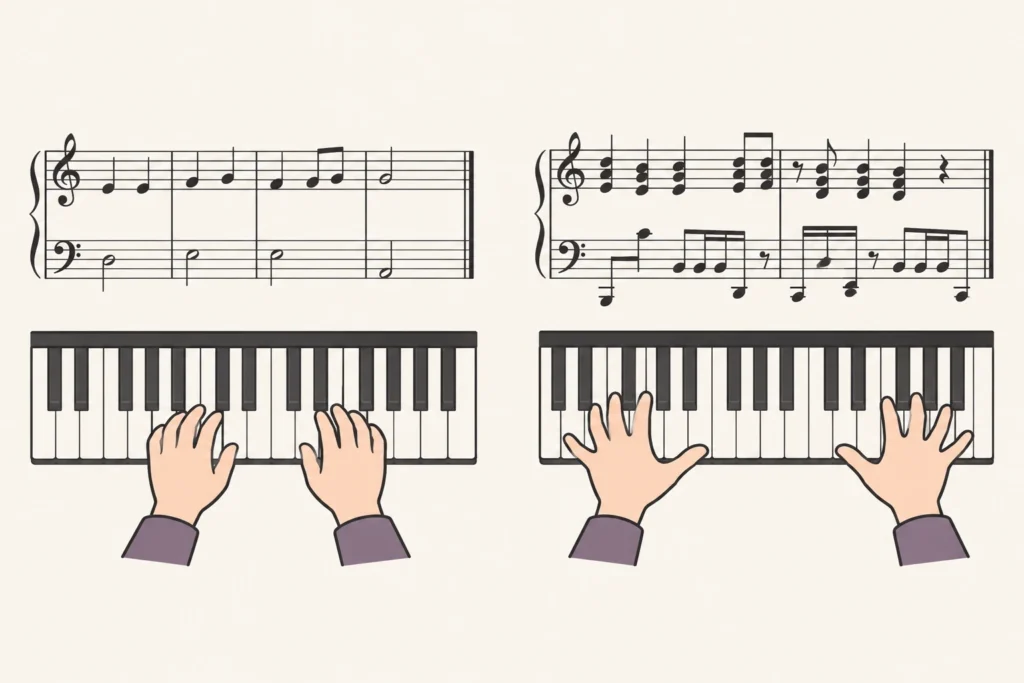
Look at your range, position changes, fingerings, articulations, and demands on breath or bow across various passages on another instrument. Determine where you’d need to learn a new physical skill before playing a passage. A passage that you can read comfortably in the hand may still not provide evidence of reading the full texture, especially in piano passages.[4]
Give the first pass a clear beginning and end
- Preview the key, meter, rests, range, and awkward entries without playing. Try to keep the amount of time previewing consistent. Thirty seconds is a convenient time to aim for, but is not necessarily the best.
- Pick a pulse you can feasibly sustain for the entire excerpt, not just the beginning. Decide on quarter note = 60 for an example in 4/4. Record the actual tempo you choose to play at.
- Play through once without fixing anything, and then listen back to the recording. If you lose your place look for the next beat or bar and rejoin from there, rather than restarting the passage.
Don’t pre-play before the home check. This is more strict than some exams, for example Trinity’s February 2026 piano specification states you are allowed to pre-play for 30 seconds. If you pre-play, record that pre-play rather than treating that as an untouched first take.[4]
Listen for four different things
Music studies have assessed performance elements individually such as maintaining tempo, repeating, hesitating and others. I would also assess elements of performance this way, rather than viewing this home record as a formal assessment.[2][3]
- Continuity: Did the pulse keep moving? Note stops, hesitations, or restarts.
- Rhythm: Were note lengths and rests correct? You may have tapped a steady beat while giving an eighth note pair two beats instead of one.
- Pitch: Note wrong and omitted notes. Keeping time by dropping the accompaniment isn't reading the full part.
- Recovery: After a breakdown, did you rejoin on the next beat, the next measure, or later? Returning to the correct place doesn’t nullify the missed notes. If nothing disrupted your alignment, recovery wasn’t tested.
Let the second attempt do a different job
As for the hypothetical piano example, your note might be: no restart; eighth note pair given two beats; two wrong pitches; back in alignment the next measure. This is more helpful than just “went badly.” I’d address the rhythm problem first. Count the eighth note pair as one beat and then re-insert it where it belongs in the phrase. Keep the note even if repeating it makes the passage sound better. This improvement doesn’t tell you how much counting, recognition, memory, or change in tempo facilitated the passage.
Rehearsal isn't the enemy. A study of three advanced adolescent flutists combined rehearsal, instruction, feedback, and varied examples, then assessed unseen pieces. Errors decreased, but the study didn't account for practice and couldn't define the optimal amount of attempts.[2]
You don't have to toss the used page. Keep it for corrections and use a new excerpt for a check. Be sure to aim for similar length, textures, ranges, and tempo, while previewing for differences. Home comparisons won't be perfectly aligned, so I wouldn't say progress was being made with the presence of a better page. Work to find fewer and fewer errors in rhythm, and fewer wrong or omitted pitches, and quicker rejoining without extra omissions. This is essentially a way to find out if the work survives something that you haven't previously learned.
Sources and references
- Journal of Eye Movement Research: Puurtinen, Eye on Music Reading: A Methodological Review of Studies from 1994 to 2017 (2018-05-01)
- Journal of Applied Behavior Analysis; full text hosted by ERIC: Dib and Sturmey, Effects of General-Case Training, Instructions, Rehearsal, and Feedback on the Reduction of Sight-Reading Errors by Competent Musicians (2011)
- Frontiers in Psychology: Herrero and Carriedo, The Contributions of Updating in Working Memory Sub-Processes for Sight-Reading Music Beyond Age and Practice Effects (2019-05-15)
- Trinity College London: Trinity College London Piano Syllabus, online edition February 2026 (2026-02)