
The stubborn myth in music training is that more minutes automatically mean better playing. In real practice rooms, the opposite often happens late in a session: attention gets less stable, muscles start compensating, timing loosens, and the player begins rehearsing errors instead of correcting them. Motor-learning research distinguishes durable learning from short-term performance effects such as warm-up and fatigue, and music-specific fatigue research has found that exhausting piano tasks can worsen musical parameters including key velocity and, in some cases, note-event accuracy. For students, working musicians, and families paying for lessons, accompanists, or room time, that means the least accurate part of practice can also be the worst use of limited hours. (pubmed.ncbi.nlm.nih.gov)
TL;DR
- Long, uninterrupted practice tends to stack transient performance problems such as fatigue and attention drift on top of whatever you are trying to learn. (pubmed.ncbi.nlm.nih.gov)
- Short breaks often help the next attempt, but a better take right after a break does not always mean better long-term learning. (pmc.ncbi.nlm.nih.gov)
- A practical starting point for accuracy work is 20 to 30 focused minutes followed by 3 to 5 minutes away from the instrument; musician-health guidance commonly uses 5 minutes of rest for every 25 minutes of playing. (pmc.ncbi.nlm.nih.gov)
- Track return on practice, not raw time. If clean reps fall and repeat mistakes rise, you are probably past the point where more volume helps.
- Longer sessions still have a place for recital prep, audition run-throughs, pit work, and ensemble stamina. They just should not be your default format for detailed correction work.

What actually goes wrong in a marathon session
One reason long practice feels productive is that the first stretch of a session often includes warm-up gains. Your hands settle, your ears recalibrate, and the passage starts feeling more familiar. But the same motor-learning literature that describes those early gains also points to later-session fatigue as a separate, transient force that can depress performance inside the session. In plain English, playing better after 15 minutes does not prove you should keep going for 90 without a reset. (pubmed.ncbi.nlm.nih.gov)
Attention is the other quiet problem. Research on sustained attention describes a vigilance decrement over time and shows that moment-to-moment lapses can meaningfully hurt performance. Music practice depends on exactly the kind of control that suffers first when focus thins out: hearing whether a note center is clean, feeling whether a shift is truly relaxed, and noticing whether rhythm is stable instead of merely familiar. Once your brain starts filling in the gaps, you can keep playing while learning less. (pubmed.ncbi.nlm.nih.gov)
Physical fatigue matters too, especially on instruments that demand fine, repetitive motion. A study on pianists found that exhausting repetitive piano tasks produced local forearm fatigue and negatively affected musical parameters, including key velocity and, in one task, note-event accuracy. That does not mean every 40-minute practice block is harmful. It does mean there is a real point where tired movement stops being the same movement you are trying to train. (pmc.ncbi.nlm.nih.gov)
Rest is not wasted time. Studies of early motor learning have found improvements during brief rest periods, and other work suggests that time away from practice can improve motor efficiency. At the same time, newer research argues that the immediate post-break bump can be partly transient, so musicians should not confuse a fresher next take with permanent learning. A useful rule is to judge a break by whether it improves tomorrow’s first run, not only the next 20 seconds. Sleep matters for the same reason: motor memory consolidation has documented sleep-dependent effects, so late-night brute force is often a weaker bet than a cleaner stopping point and real recovery. (pmc.ncbi.nlm.nih.gov)
Use the Accuracy Return Audit
Another way to think about this could be: “What is my Return On Investment for practice?” The ‘Accuracy’ Return Audit can be completed in ten minute intervals. You will create a baseline in the first ten minutes of your time block and compare your second, third, etc to that baseline score. The purpose of this audit is to identify the point at which more repetitions produce a lower quality repetition.
| Metric | Baseline in first 10 minutes | Warning sign | Hard stop signal | Best response |
|---|---|---|---|---|
| Clean reps | Your normal clean takes at the target tempo | Clean reps fall by about 20 percent | Clean reps fall by 25 percent or more for two check-ins | Take a break or switch tasks |
| Repeat mistakes | One-off misses that disappear after correction | The same miss shows up twice | The same miss shows up three times at the same tempo | Lower tempo by 8 to 12 bpm and isolate the chunk |
| Body tension | Normal breathing and loose jaw, shoulders, and hands | You feel gripping or breath-holding | You feel obvious gripping, pain, or shaky control | Stand up, reset, or end detail work |
| Attention | You can describe the exact goal of the rep | You catch yourself zoning out | You cannot say what improved on the last rep | Stop precision work and move to notes review or recording review |
Do not end a block because of one ugly take. End it because the pattern has changed. If two check-ins in a row show lower clean-rep return, more repeat errors, or more gripping, you are probably past the point where volume is helping accuracy. A good default is to audit inside a 20- to 30-minute block, then step away completely for a few minutes. Musician-health guidance often recommends roughly 5 minutes of rest for every 25 minutes of playing, which is a sensible starting point if you do not yet know your personal limit. (pmc.ncbi.nlm.nih.gov)

A smarter way to structure practice
Research on practice distribution shows that structure matters, not just volume, and music-specific motor-learning research has looked at the role of tempo variability and practice scheduling rather than assuming endless identical repetition is best. That is the right way to think about a session: build it around purpose, reset, and testing. (pubmed.ncbi.nlm.nih.gov)
- Pick one job for the block. Examples: clean a four-bar shift, stabilize sixteenth-note timing, or lock a difficult entrance. If the goal is vague, the block will drift.
- Use the first 3 to 5 minutes to warm up and set a baseline. Play slowly enough that you can hear and feel what correct actually is.
- Work in small chunks. For detail work, 1 to 4 measures is usually more useful than full run-throughs.
- Change one variable at a time. Keep the fingering fixed while you alter tempo, rhythm, articulation, or starting point.
- Take a real reset. Stand up, unclench the jaw, move the shoulders, hydrate, and look away from the stand. Phone scrolling is usually not a real reset.
- End with one recorded test take and one short note to yourself about tomorrow’s first task.
| Primary goal | Typical block length | Most useful format | Switch or stop when |
|---|---|---|---|
| Technical passage cleanup | 20 to 25 minutes | Slow work, chunking, rhythm change, and test takes | The same miss repeats three times at the same tempo |
| Sight-reading or repertoire maintenance | 15 to 20 minutes | Forward motion with limited stopping | Pulse breaks down and your eyes stop tracking ahead |
| Memorization | 15 to 25 minutes | Chunk recall away from the instrument, then re-entry practice | You cannot retrieve the same entry point twice |
| Performance simulation or endurance | 30 to 45 minutes | Full run-through or extended section work | Tone, posture, breathing, or control clearly deteriorate |
A realistic example with time and money
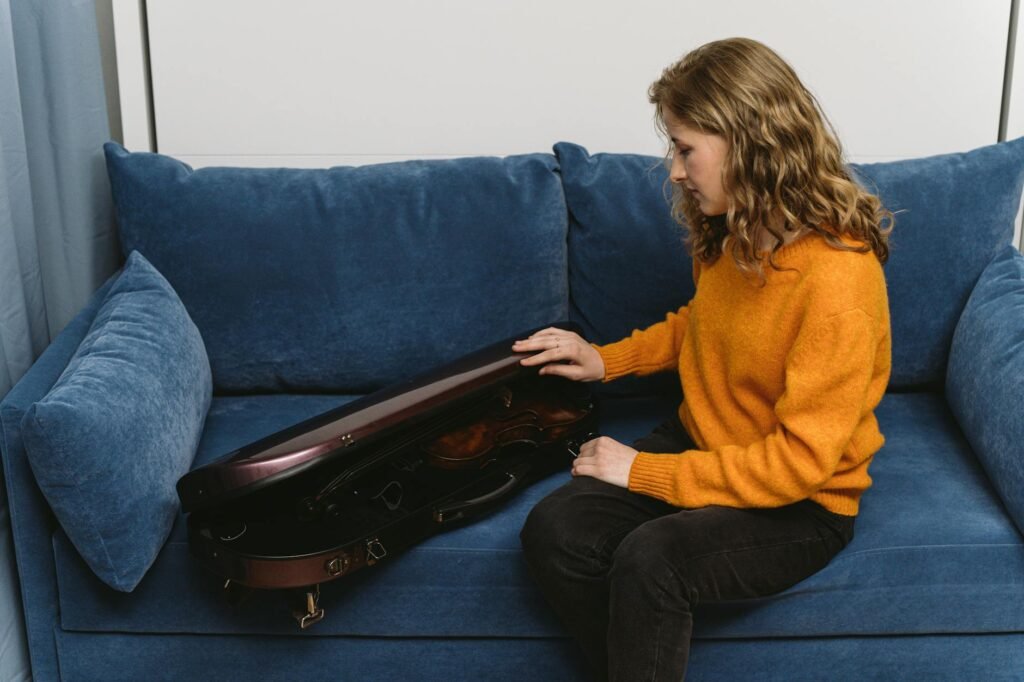
Consider a composite example. A college violinist has a 90-minute evening window and rents a practice room for $10 an hour. In a single 90-minute block on an audition excerpt, the first 30 minutes produce 15 clean reps out of 22 attempts. The last 30 minutes produce 7 clean reps out of 22, plus recurring bow noise on the string crossing that was not there earlier. That final half hour costs $5 and mostly rehearses the tired version of the passage. The next week, the player uses a 25-5-25-5-20 split. Clean reps stay more even across the session, and the next-morning first take is cleaner because fewer bad reps were engraved the night before. The point is not that shorter blocks are magical. The point is that accuracy has a return curve, and long sessions often hide when the return has turned negative.
When the shorter-block plan is not enough
Some musical demands are genuinely long. Recitals, auditions, pit work, church services, marching assignments, and ensemble rehearsals all require stamina, recovery, and concentration over time. So this is not an argument against long sessions in every context. It is an argument against using long, unbroken sessions as your default tool for accuracy. A better split is to separate precision work from simulation work. Do your clean, corrective practice while the body and ears are fresh. Then, if needed, do a later run-through that you honestly label stamina practice, not note-fixing. That keeps you from blaming yourself for missing details during a block that was never designed for detail. (pubmed.ncbi.nlm.nih.gov)
If shorter blocks do not improve accuracy after a week or two, the problem may not be session length. It may be chunk size, unstable fingering, a tempo target that is still too high, an instrument setup issue, or simple fatigue outside the practice room. Sleep-dependent motor memory effects mean recovery is part of the training plan, not a bonus. And if pain, weakness, tingling, or numbness enters the picture, stop treating the issue like a discipline problem. Research reviews report high rates of musculoskeletal disorders among musicians, with higher rates in players facing intense practice schedules, and musician-health guidance explicitly favors frequent breaks and modified loads when symptoms appear. (pubmed.ncbi.nlm.nih.gov)
Common mistakes that make long practice worse
- Counting hours instead of counting clean reps.
- Raising the metronome after one good take instead of after three stable ones.
- Doing full-speed run-throughs before solving the smallest technical problem.
- Using a break to scroll on your phone instead of physically and mentally resetting.
- Repeating the same wrong motion over and over because stopping feels like losing momentum.
- Ignoring setup variables such as reed quality, stick condition, bow distribution, seat height, lighting, or page turns.
How to pressure-test the advice on yourself
Do not trust the feeling of a heroic session. Test the result. Because post-break boosts can be transient and sleep influences consolidation, next-day performance is a better judge than the mood at the end of practice. (pubmed.ncbi.nlm.nih.gov)
- Pick one excerpt that is hard but not impossible.
- For three practice days, use one long block. Record the first full take and the final full take.
- For the next three practice days, use split blocks with real breaks. Record the first full take and the final full take again.
- The next morning, count wrong notes, restarts, rhythm slips, and obvious tension signs from the recordings without looking at which day used which format.
- Keep the format that gives you the better next-day first take, not the one that merely felt intense.
Warning: This article is informational, not medical advice. If practice brings pain, numbness, weakness, tingling, or loss of control, reduce load and consult a qualified teacher and an appropriate healthcare professional familiar with musicians.
Bottom line
Longer practice sessions can make musicians less accurate because practice time is not one thing. Early in a session, you may be gaining fluency. Later, you may be fighting fatigue, attention drift, and compensatory movement. The fix is not simply to practice less. It is to protect the part of practice that still has a positive return. Shorter, more deliberate blocks with real resets usually produce cleaner reps, better next-day retention, and a better use of the time and money music training already demands. (pubmed.ncbi.nlm.nih.gov)
FAQ
Is a two-hour practice session always bad?
No. A two-hour block is not automatically harmful, but it is usually a poor default for detail work. Research on practice distribution shows that performance inside a session is shaped by transient factors such as fatigue, and musician-health guidance favors frequent breaks over endless continuous playing. Use long sessions mainly for run-throughs, rehearsal prep, or stamina work, not for your most delicate correction work. (pubmed.ncbi.nlm.nih.gov)
How long should a practice block be if accuracy is the goal?
A sensible starting point is 20 to 30 minutes of focused work followed by 3 to 5 minutes fully away from the instrument. A commonly cited practical benchmark in musician-health guidance is 5 minutes of rest for every 25 minutes of playing. (pmc.ncbi.nlm.nih.gov)
Why do I sometimes sound better right after a break?
Short rest can improve the next attempt. Studies of early motor learning have found gains during brief rest periods, but newer work suggests that some of that post-break improvement is transient and should not automatically be treated as durable learning. (pmc.ncbi.nlm.nih.gov)
Does sleep matter more than one more late-night repetition?
Sometimes, yes. Motor memory consolidation has sleep-dependent effects, which means the clean rep you stop on and sleep on may be worth more than the sloppy rep you force late at night. (pubmed.ncbi.nlm.nih.gov)
I need endurance for auditions and gigs. Should I stop doing long run-throughs?
No. Performance settings require stamina. The better move is to separate jobs. Use shorter fresh blocks for precision and correction, then schedule longer sessions for simulation and endurance. If pain or clear physical deterioration appears, do not push through it as if it were only a motivation problem. (pubmed.ncbi.nlm.nih.gov)
References
- Unifying practice schedules in the timescales of motor learning and performance – https://pubmed.ncbi.nlm.nih.gov/29684760/
- Recent theoretical, neural, and clinical advances in sustained attention research – https://pubmed.ncbi.nlm.nih.gov/28260249/
- Mental Fatigue and Sport-Specific Psychomotor Performance: A Systematic Review – https://pubmed.ncbi.nlm.nih.gov/33710524/
- Exhausting repetitive piano tasks lead to local forearm manifestation of muscle fatigue and negatively affect musical parameters – https://pmc.ncbi.nlm.nih.gov/articles/PMC8047012/
- Optimizing effort: increased efficiency of motor memory with time away from practice – https://pubmed.ncbi.nlm.nih.gov/25355964/
- Mechanisms of offline motor learning at a microscale of seconds in large-scale crowdsourced data – https://pmc.ncbi.nlm.nih.gov/articles/PMC7272649/
- Micro-offline gains do not reflect offline learning during early motor skill acquisition in humans – https://pubmed.ncbi.nlm.nih.gov/41150724/
- Sleep-dependent motor memory consolidation in healthy adults: A meta-analysis – https://pubmed.ncbi.nlm.nih.gov/32730847/
- Evidence-informed physical therapy management of performance-related musculoskeletal disorders in musicians – https://pmc.ncbi.nlm.nih.gov/articles/PMC4086404/
- Dissociable effects of practice variability on learning motor and timing skills – https://journals.plos.org/plosone/article?id=10.1371/journal.pone.0193580
- Musculoskeletal disorders in musicians: an overview of systematic reviews – https://pubmed.ncbi.nlm.nih.gov/41691705/