
Provide a few passages that are representative of what your piece needs from the instrument. When you arrive, situate yourself, play those passages, and adjust only what the sound justifies. I’d preserve familiar fingering, musical pulse, and phrase direction before trying to make the instrument feel like the one at home.
An unfamiliar response doesn’t always mean you practiced poorly. This is a better question to ask than “why does everything feel wrong?”. Is your entrance quiet? Is there a melody here? Does a repeated note come back on time? Answers to questions like these give you something you can work with.
Pack a small musical test, not another rehearsal
Before the day, know which instrument you’ll use, if you’re able to try it out beforehand, and what kind of changes to the setup will be allowed. After that, mark some passages in your score. Approach and exit, for example, an isolated chord, won’t tell you if you can enter it naturally.
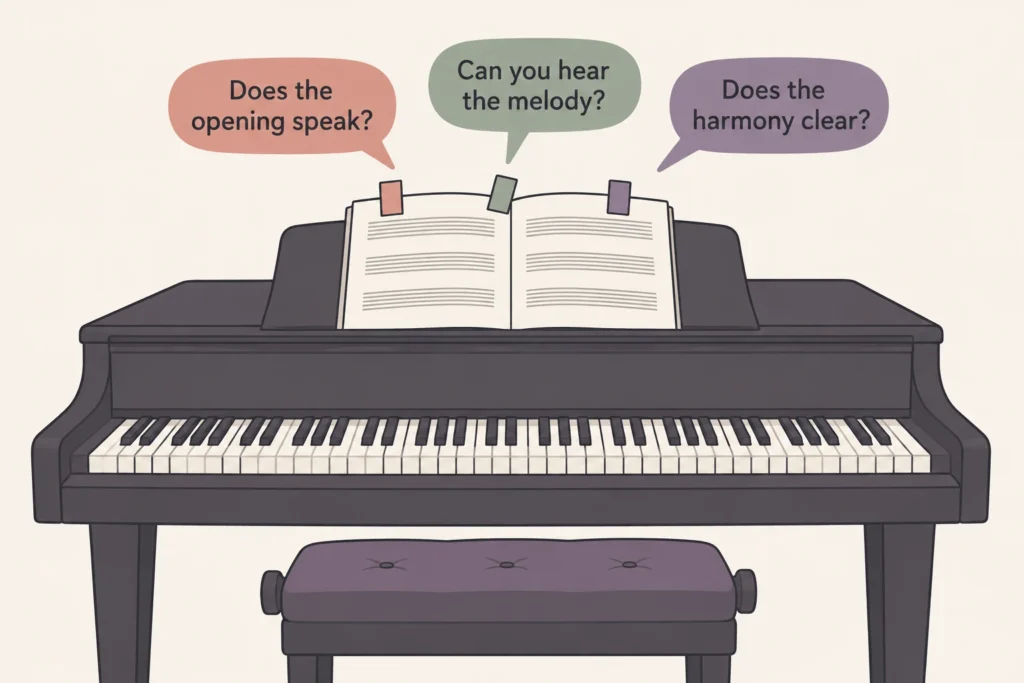
- The quiet opening: do all the intended notes sound?
- A melody over accompaniment: do you hear the melody?
- A pedaled harmony: do you hear the new harmony?
- Fast repeated notes, if present: do they sound evenly at the intended pulse without extra tension?
This is a practical sampling method, not a scientifically established best sequence. Yamaha’s brass mouthpiece guidance similarly recommends trying soft playing, moving notes, articulation, and actual repertoire rather than judging equipment only by extreme high notes. The useful idea transfers: test the demands you’ll actually perform.[8]
At the piano, separate feel from sound
Adjust the bench so you can reach the keyboard and pedals comfortably, and put the music where you can read it without leaning. Start with the opening, then the passage whose failure would most disrupt the piece. If access is brief, those matter more than completing a scale routine or playing from beginning to end.
Physical resistance, loudness, and lingering sound aren’t the same problem. Grand and upright actions have different return mechanisms, so demanding repetition deserves a trial when your piece contains it. But the category alone doesn’t tell you whether this particular piano will serve your passage. Room acoustics and lid position also affect the sound you hear; a big sound at the bench doesn’t establish what reaches the audience.[1][4]
Distinguish output volume from touch response. The touch-sensitivity setting for Yamaha’s P-255 changes the physical weight of the keys, and a manual states it will not do so. Notice that was a distinction, not a universal guarantee. Some controls are tuned to touch. Before adjusting anything, ask the host to identify the actual controls. It’s helpful to turn the amplification down, not up, if the melody is lost in the accompaniment.[2]
Change the smallest thing you can hear
Try to bring down the left-hand chords that cover the melody with a less-accompaniment version of the melody. This preserves the balance you intended without changing the whole thing to a louder performance. If your notes are not speaking, listen to see if a slight adjustment in keystroke made a difference.
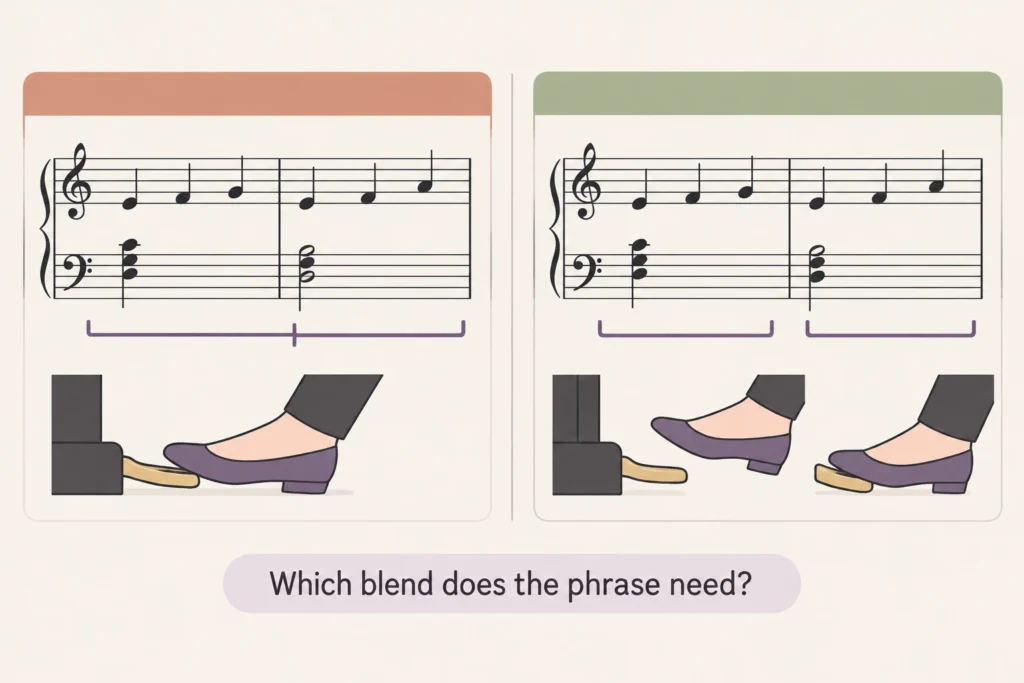
If the previous harmony is hanging over the next one, try a clear damper-pedal release before lifting and re-setting. Try the other pedals your music uses, too. Their functions can be different on different pianos.[3]
Accept the new change if the target is more clear, and if it does not introduce a new broken, jagged, or stiff sound. If a faster passage feels very uncomfortable, try to shift to a slightly slower tempo for a passage. This can help to address the observed physical limits of the instrument. It is better to slow down a passage to a more comfortable speed for a performer than to perform a passage very quickly and uncomfortably.
A study of pianists found the following adjustments from clarity, decay and balance comparisons and listening position adjustments. It shows that listening questions can be taken seriously, however it doesn’t prove how quickly a beginning student adapts to these questions. If you are able to listen from the room, ask ‘can you still hear the melody above those chords?’[5]
Borrowed strings and winds need different questions
In bowed strings, include a string crossing and a clear pitch reference. Listen for response and intonation rather than applying piano advice and think ‘more bow’ or ‘less bow.’ Try small, familiar changes in bow speed or contact point rather than sweeping changes. If in doubt, confirm with the instructor as to what tuning and adjustment changes are allowed. In its bowed string instrument guide, Yamaha states that when shifting the position of the bridge, the area under the strings is vulnerable to breakage; if you notice your bridge is out of position or visibly ‘leaning’ stop and have the teacher/owner contact an experienced person to help. Don’t attempt changes that you are unfamiliar with.[6]
For the Trumpet, use normal playing to warm the instrument before tuning, as temperature also affects pitch. Sample a quieter entrance. Listen for articulation and changes in register and use the tuning slide only with permission and familiar handling. Yamaha states that the mouthpiece should not be forced into the receiver. If a slide or the mouthpiece is stuck, do not pull or force it, have the owner contact an experienced person to help.[7]
For a reed instrument, clarify the permitted mouthpiece and reed arrangement beforehand; don’t turn arrival into an equipment audition. Test soft attacks and the register transition in your music. A difficult high note isn’t an invitation to bite harder: Yamaha’s clarinet teaching guidance specifically cautions that a tighter embouchure doesn’t necessarily improve high-note response. That’s clarinet advice, not a universal wind prescription. Persistent failure of a particular note or key needs a teacher’s comparison or technician’s inspection, not an improvised keywork repair.[9]
When access, or the instrument, doesn’t cooperate
If one piano key repeatedly stays down, fails to sound, or sustains after both key and pedal release, stop repeatedly forcing it and report the exact key and behavior to the host. The trial cannot tell you which repair is needed. Tuning, action regulation, and pedal regulation are different jobs; internal work belongs to a qualified piano technician. Ask whether the fault can be addressed or another instrument provided.[4][10]
Rehearse at home the intended entrances and why. If you have time, you can practice them on another instrument if available, however practice without resistance and try not to create tension. On the day, you should handle the permitted setup and try your best with what you have. Let actual sounds, and not your judgement, inform your decisions.
Sources and references
- Yamaha Corporation: Choosing a Piano: Grand or Upright?
- Yamaha: P-255 Owner’s Manual
- Yamaha: How to Use Keyboard Pedals
- Piano Technicians Guild: Piano Care FAQs
- Frontiers in Psychology; Royal College of Music: Playing to the room: how solo pianists perceive, understand, and adapt to acoustic conditions (2026-08-12)
- Yamaha: Violin/Viola Owner’s Manual
- Yamaha: Trumpet/Cornet/Flugelhorn/Rotary Trumpet Owner’s Manual
- Yamaha: How to Choose the Right Mouthpiece
- Yamaha: Fix It: Clarinet Teaching Tips
- Piano Technicians Guild: Piano Care: Basic Rules