
You're doing more than keeping your own beat. You're listening and anticipating next moves to adjust. While doing so, you're still playing your part. A steady personal pulse can help, but it can't always do that. It seems that your problem occurs only with others. I'd find what changes when you make a duet and then consider more practice with others.
Research on rhythmic joint action describes this combination of anticipation, attention, and adaptation. That’s a useful explanation of the extra task, not a diagnosis of your particular stumble. The practical question is where coordination breaks: throughout the passage, on one entrance, or when the sound around you changes.
Find the moment when the two versions stop matching
Decide on four to eight measures with the troublesome transition. Play them with a partner supplying a simplified part and with the full partner part at the same agreed tempo and phrasing. Simplified could mean the partner plays only the main beat-bearing notes. Compare your part with the simplified and full partner parts, and make any changes necessary to be sure it's comparable. This can be done in practice.
If you have means to record your efforts, do so. With the help of a click, you can check to see if your solo playing is drifting. Listening to click over and over again can be boring. Be sure the problem you have is not just a little tempo difference, because that can occur without other issues. Other issues may be an entrance on the wrong beat and an attack that's not in time. These can all be checked with the help of a metronome.
Imagine I’m playing a duet and come back late after a rest. I’m angry because the notes were fine at home. Then we strip the accompaniment down, and I notice I’ve been waiting for a chord that shows up at the same time as my entrance. I can’t use that chord to prepare my entrance. Instead of repeating the notes, I want to practice going there.
If the simplified version of the duet works but the full version doesn’t, the added texture is a clue: maybe your reference gets buried, or a busy figure pulls your attention away from counting. If you return a whole beat late for both versions, check the rest’s length and your place in the measure. If you gradually separate even while playing continuously, check your sense of pulse and adjustment. These comparisons help focus the cause of the problem.
Listen for what prepares the entrance
Try a four-measure example in 4/4 with quarter note = 72. You play measure 1, rest during measure 2, and resume on measure 3, beat 1. Initially, your partner makes quarter-note attacks on all four beats of measure 2. Count the rest and prepare your movement to the shared downbeat; don’t wait to hear it.
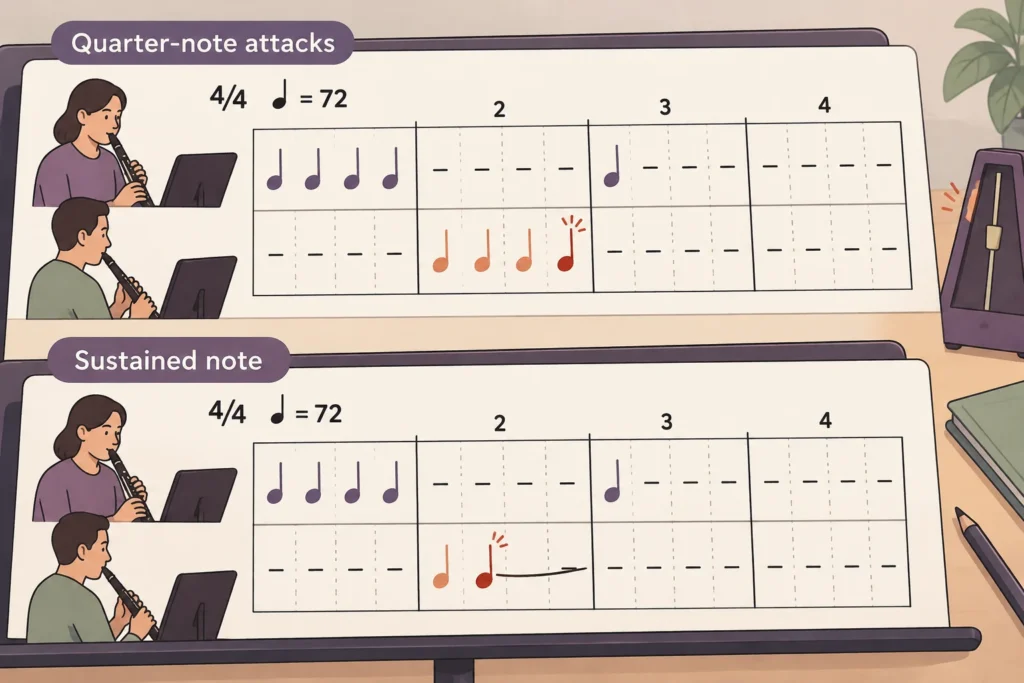
Next, your partner plays on beats 1 and 2 of measure 2, then holds the note through beats 3 and 4. Agree your partner will give a small preparatory breath or movement on beat 4 to help you anticipate their return.
This is not a free rein to ignore your partner. Your partner leading with beats helps you anticipate the shared arrival; the sound of the arrival tells you how it went. There are many studies showing that, with skilled pianists, the presence of a video of the pianist (often a recording) with the audio on, aided synchronization more than video with the audio off. I’m a fan of using eye contact to fill in missing information.
A click, a track, and a partner teach different things
| Practice aid | What it gives you | What it cannot do |
|---|---|---|
| Click | An external pulse for checking drift and beat placement | Provide another musical part or negotiate phrasing |
| Fixed musical recording | Another part, texture changes, and potentially expressive timing | Hear your entrance and change its timing in response |
| Live partner | Audible and visual cues, plus the possibility of mutual adjustment | Guarantee a steady reference or resolve unclear leadership without discussion |
Tracks are useful for practicing your part in the face of competing sound. They’re not a lessor tool. Successful practice with a track does not serve two-way coordination; the recording continues regardless of what you do. So if you’re comfortable only practicing with a single track, try different tempos and recordings, then practice with a live partner. Limitations are in what the task leaves unpracticed, not because backing tracks foster a reliance.
Bring back the music without losing the connection
Try the reduced duet until you time your entrance and stay coordinated through measure 4. Next, try the sustained-note version. If that is workable, add the partner’s full texture while keeping the agreed preparatory cue. Finally, include the previous phrase as well as the next transitional sound. I want the return to be owned by the music rather than to rely on a trick to give you an aligned entrance.
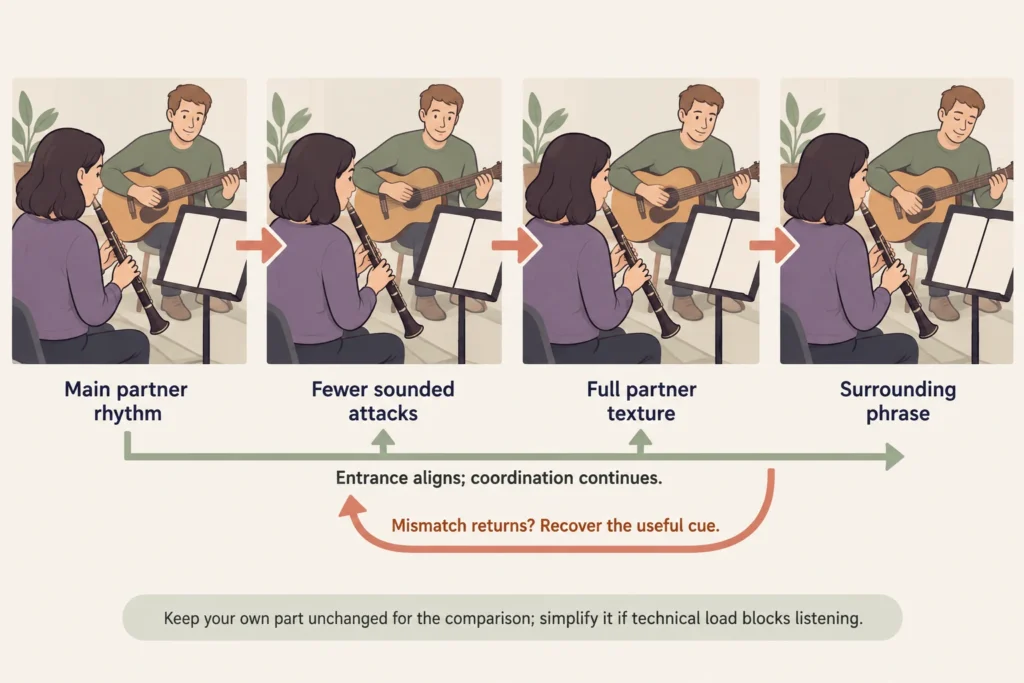
You’ve reached a state of alignment when you hear an intended entrance and continue to stay coordinated with a texture change in multiple attempts rather than because of some arbitrary repetition count. If full coordination returns and you are unable to maintain full control and focus, remove the full coordination, and determine what cue went away. If you aren’t able to maintain control, simplify your part.
Agree on who shapes the slowdown and who cues the return before adding expressive timing. There is not a one to one correspondence between mutual adjustment and a fight for leadership. The duet piano study found evidence of adjustment in both directions, despite a preset leader/follower role. Conducted or click-led groups also have their own group timing. Not every audible difference is a mistake. Judge it against what was intended for articulation and phrasing.[2][4]
Sources and references
- Philosophical Transactions of the Royal Society B; indexed by PubMed: Rhythm in joint action: psychological and neurophysiological mechanisms for real-time interpersonal coordination (2014-12-19)
- Music Perception; author manuscript hosted by Johannes Kepler University Linz: Synchronization of Timing and Motion Among Performing Musicians (2009)
- Musicae Scientiae / SAGE: When they listen and when they watch: Pianists’ use of nonverbal audio and visual cues during duet performance (2015)
- Minnesota String and Orchestra Teachers Association, String Notes: Chamber Music: Maximizing Limited Rehearsal Time (2010)