
Set a metronome when you want a reference for a specific timing problem. A click in the beat shows where the pulse has drifted, while a click in the subdivision shows a beat position. If there are not enough clicks, there is more time to carry a pulse independently. Take the metronome away to see if the improvement is heard and to listen to the phrase instead of chasing after the click.
I wouldn't give you a set percentage for practice. What’s important is the learning during that time. If your landings are neat with the click, that’s good, but I’d like to hear what’s between those landings, and when the help stops.
Listen for what moves, not just what misses
Picture me at a piano in an imagined practice session, dutifully landing each downbeat with the click while squeezing the intervening eighth notes together. There’s a little lurch towards the end of the phrase. I can’t be sure if the problem is with the tempo, so I’ll have clicks on eighth notes instead. The missing info is between beats, and those are the bits I need to work on.
Listen for the place where the mismatch is worst. If beats line up around an early offbeat point, that means you’re placing beats within the beat. If beats line up around the onbeat, that means you’re drifting. If you're late only at a shift, chord change, or a breath, then look into that before considering pulse practice.
To solve that local snag, try tapping along to the passage at its indicated tempo, then playing it. Sometimes fluent tapping is followed by a delay in the instrumentation. Movement preparation, reading, or coordination could be factors. The passage doesn't say which is responsible. Nor does tapping tell us anything about the instrumentation question. Finger-tapping tasks, in fact, may not completely replicate the movements in playing an instrument, according to some research.[3]
Same rhythm, different information
One bar of 4/4 time consists of two eighth notes on the first beat, a quarter note rest on the second beat, two eighth notes on the third beat, and a quarter note on the fourth beat. Count “1 & 2 & 3 & 4 &." The attacks occur on the first, following second, third, and fourth beats, respectively. Repeat this for four bars at quarter note = 60. Use the pitch that is most comfortable to you.
Keep settings like pitch, rhythm, articulation, tempo, and length of each four-bar phrase the same while adjusting the reference below. In the case of 120 eighth-note clicks per minute, it does not mean you double the speed of the music.
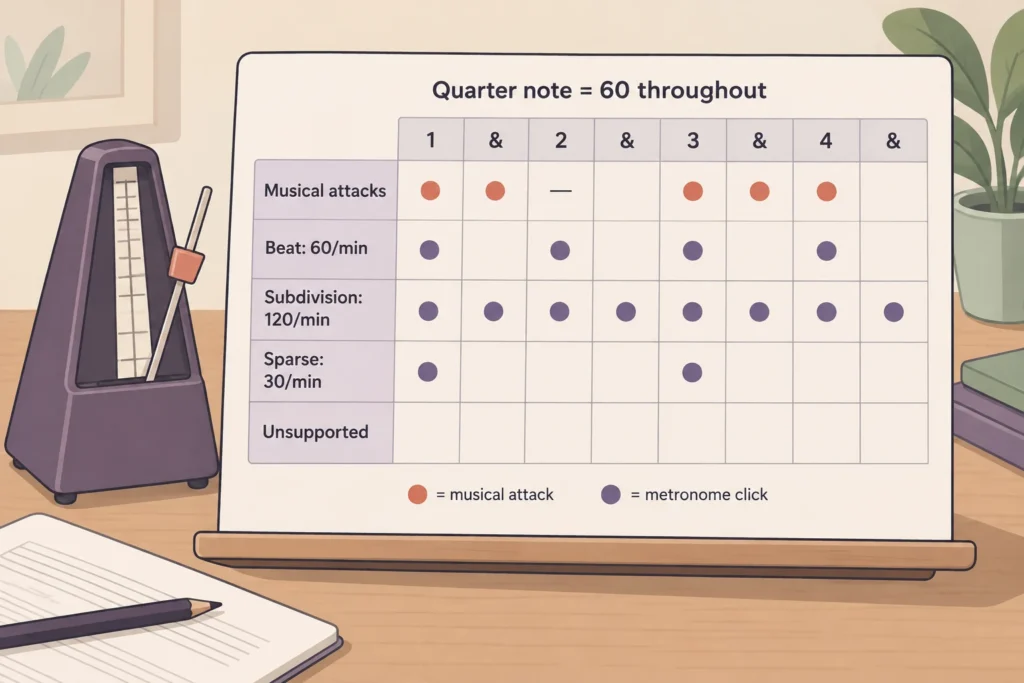
| Reference | Audible clicks | What to listen for | What success leaves untested |
|---|---|---|---|
| Beat clicks | 60/min, on 1, 2, 3, 4 | Do beat arrivals drift? Does the rest keep its place? | The offbeat eighth notes can still be misplaced. |
| Subdivision clicks | 120/min, on every number and & | Do both eighth notes occupy their intended positions? | The click supplies those intermediate positions; unsupported placement remains untested. |
| Sparse clicks | 30/min, on 1 and 3 | Can you carry beats 2 and 4 between references? | Matching the next click doesn’t prove the events inside the gap were even. |
| No ongoing click | None after the same count-in | Does the rhythm retain its spacing, rest, and overall pace? | Listening alone is a less precise tempo comparison; a recording helps. |
If your app creates eighth-note subdivisions, keep the quarter-note tempo set to 60. On a basic metronome without that feature, set it to 120 and imagine each click is an eighth note. For clicks that are too far apart, set it to 30 and assign them to beats 1 and 3, not to consecutive quarter notes. I’m more concerned with the assignment than the number shown on the display.
Sparse clicks aren't a demotion. Maintaining the pulse with missing references gives you something to listen for. Searching for an eighth note with sparse references is a good thing. The Berklee College of Music’s rhythm curriculum addresses conditions like on-beat, alternate-beat and audible/inaudible, but that is in the context of a practice assignment, not a performance evaluation.[4]
You can still count subdivisions when the clicks are far apart. A study on musically trained participants, self-generated subdivision reduced tapping variability, particularly at longer intervals, which included 1-3.25 second intervals. This offers evidence for an “1 & 2 &” in your head, however I wouldn't assume a similar result for other areas of musical training.[2]
Give the click a job, then take it away
A detail you can actually hear might be something like “the offbeat stops arriving early,” for example. Record a short unsupported attempt after a count-in, then try the click setting that exposes that detail, keeping the tempo and material unchanged. If the passage is too demanding to listen to clearly, simplify it before comparing settings, not halfway through, when you would have no idea what caused the difference.
With support, you’re looking for the chosen detail to hold across multiple attempts. For instance, the detail might be no separation from the beat clicks, no early offbeat against the subdivision clicks, or no rushed catch up and pull ahead after the troubling transition. Listen for releases and rests, too. A note can start on time and end too soon. Now record the same passage without the click, using the same count-in, and compare both the spacing of beats and the overall pace. If the early offbeat returns, try supported and unsupported attempts. If the rhythm is clear, but a shift is heard, adding clicks may not resolve the issue.
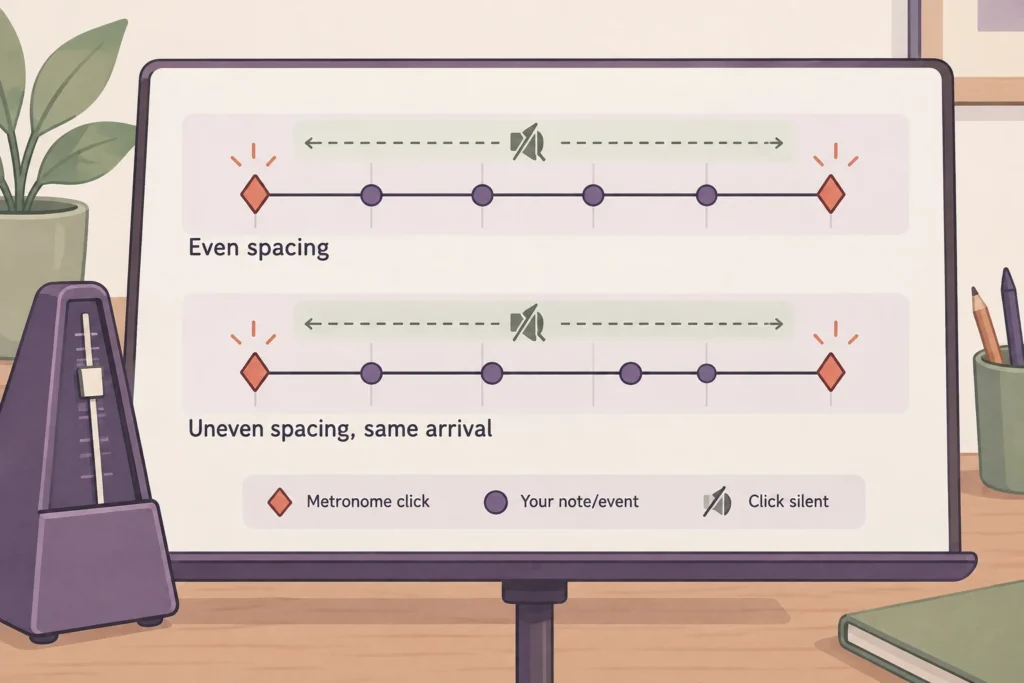
You can check alignment in other ways. For example, during silent practice, you can keep the music going in your mind and listen for where the click returns. Manually restarting a stopped metronome doesn’t work because the first click after the reset is a new timing reference. Scheduled returns tell you about your arrivals, but you could rush one interval and, during the next, stretch the music to meet the click, which divides a gap with imperfect music. I keep the recording because I think you can gain insights other ways.
Some research distinguishes synchronization with an external rhythm from continuation after it stops. So, you can check both and not assume that practice with the metronome can’t be of any help. I don’t think it validates this particular home practice, or prescribes a general click schedule. I suggest you simplify, and listen again at a later session. The practice has to touch the instruments true notes and movements. You may find the guidance is spot on.[1][3]
The click doesn’t hear the whole phrase
With music, you can practice beginnings as attacks. You can practice a melody and use the pedal to blend notes. On a wind instrument, you can practice breath and air to adjust the phrasing. You can practice shifting on the string and slow it down, so the next note is exactly where it should be. These details are good, but the click can't tell you these things. It's a challenge earning each landing.
Strict alignment means that you won’t be able to utilize expressive timing. Research has been done on expert cellists and pianists, observing repeated performances and measuring the variations in speed related to phrasing. This research shows that neither of the performers follow a strict rule and that variations in the click track might help explain some phrasing. This shows that an unchanging click track isn’t necessarily the best method to achieve precise performance.[5]
For the expressive section of a piece, you’re looking for climaxes, arrivals, and releases. Listen to the sound of the passage and try removing the click. When doing this, you want to hear where the phrase wants to go and is likely to settle. You want broadening to help the phrase come to rest. When listening to a performance, the goal should be to hear intention and a shape that expresses the phrasing. You want the phrase to be designed by the performer and not random or unfocused. This shape and intention should be expressed and available for the performer to use, regardless of if there is an external source to help with alignment.
Sources and references
- Psychonomic Bulletin & Review / Springer Nature: Sensorimotor synchronization: A review of recent research (2006-2012) (2013)
- Music Perception / University of California Press: Self-Generated Interval Subdivision Reduces Variability of Synchronization with a Very Slow Metronome (2010-06-01)
- Frontiers in Psychology: The Impact of Instrument-Specific Musical Training on Rhythm Perception and Production (2016)
- Berklee Online: Time and Rhythm 1
- Frontiers in Psychology: Flexibility of Expressive Timing in Repeated Musical Performances (2016-10-04)