
You need to practice hands separately when there are issues with notes, fingering, and/or rhythm with a part. You practice hands together when the issue has to do with how the parts relate to each other. With issues like this, you practice hands together, and switch between the problems as necessary. I practice the hands separately only as much as necessary to work out the difficulties each part needs to work out. I don’t wait to practice the hands together to iron out where the parts don’t relate to each other to work out if they can share a single beat.
Picture me in an imagined practice session, with ten minutes left before dinner: the right hand flows, the left hand flows, and together they stumble at the same entrance. I’m tempted to give each hand another victory lap. Instead, I slow the combined passage and listen to the entrance. That’s the relationship the solo versions never asked me to play.
What changes when the other hand joins?
Choose the short excerpt that breaks down. Try it together, then with each hand alone, at the same initial pulse. Comparing a brisk solo version with a much slower combined version muddies the question. Listen for the specific hesitation, wrong note, or displaced attack, not just whether you reach the end.
If the same issue occurs when the part is practiced by itself, isolation solves the issue. If there isn't an issue when the part is practiced by itself, but there is when the combined part is practiced, spend more time with the combined part. This can help determine the problem (reading two staves, dividing attention, or changing a movement), and can also help relieve the stress of not knowing where the problem is. Conversely, removing the other part may help eliminate a relevant musical cue. This isn't always true. A passage practiced by itself can be practiced to perfection, and the test to integrate it can be done when the passage is practiced with the other hand.
One bar, two different repairs
This is a 4/4 example, with the left hand playing a quarter note triplet of C3, G3, C3, G3. The right hand has an eighth rest, C5 in the right hand for the eighth note on the “and” of beat 1, D5 for the quarter note on beat 2, and E5 for the half note on beat 3. Count “1 and 2 and 3 and 4 and.”
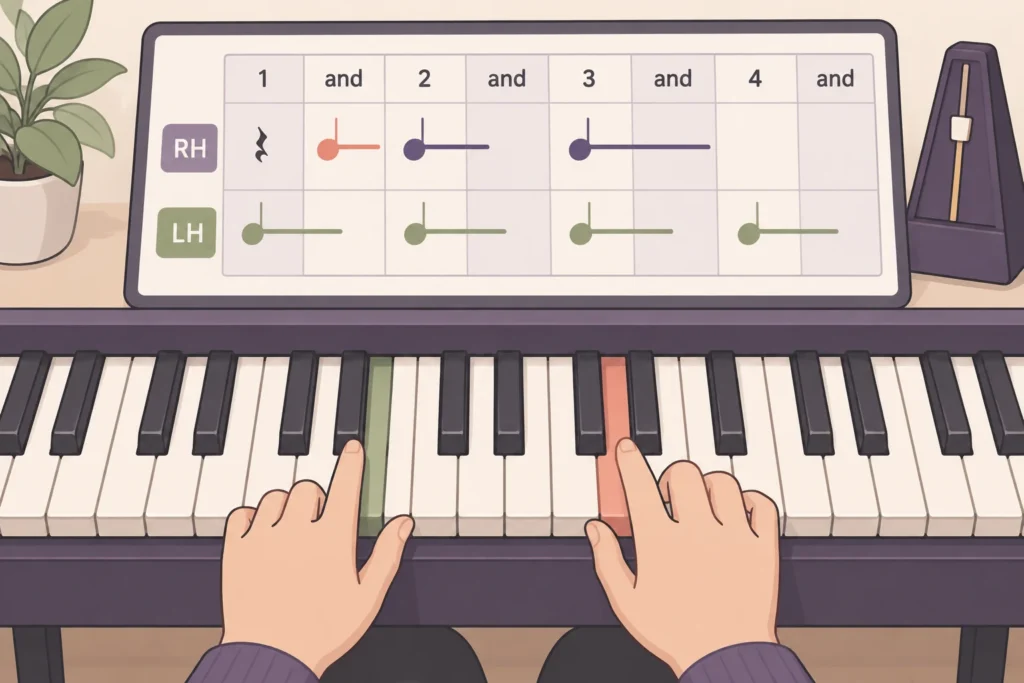
Let's say when the right hand plays C5, it lands on beat 1. Work separately. For the right hand, count the eighth rest and place the C on the “and,” and continue to D on beat 2. The silence is part of the rhythm. With this clear, bring the left hand back immediately, and listen to see if C lands between the two attacks.
Now let's say the right-hand rhythm is clear on its own, but when combined with the left-hand rhythm, C gets pulled onto the left-hand downbeat, or D comes after the left-hand G. Soloing more won't help with that. Practice both hands going slowly together or tapping out their attack rhythms with your hands, and then playing the notes. Listen for three things: the left hand by itself on 1, the right hand by itself on the “and” of 2, and both hands together on 2. They attack again on 3. The right hand holds the E on 3, while the left hand continues on 4.
To help with denser passages, reduce the chords in the right-hand accompaniment to a single notes, while keeping the rhythm of the chords. This kind of simplification and combining of phrases is given in practitioner guidance, and I think it’s good because you can cut down the amount of notes you need to play, while keeping the relationship you need to hear.[3]
Let the combined phrase judge the repair
Alternating means switching from combined to separate practice. Alternate only complete phrases, not individual notes. Make a separate-hand repair. Reconnect, and let what you hear choose the next visit. Arrive at the beat so you practice arriving, not launching from a convenient stop. Play the subsequent phrase to see if the shared attacks are met and if the melody is articulated without a catch.
It is possible that the assumed universal practice recipe is actually a guided choice. Of 34 expert pianists, the study found that when practicing scales separately and combined, there were timing variations in addition to coupling. The study focused on performances and not which practice schedule teaches beginners best. In a different, four-day laboratory study, the transfer was limited when one-hand practice was compared to two-hand practice; it had nothing to do with piano repertoire.[1][2]
The studies do not mention a recommended separate-to-together repetition ratio. The early reconnection check is based on experience. If your teacher assigns separate practice, you should be empowered to ask, “Which specific detail should this help improve and what should I listen for when I combine?” This maintains the intent of the assignment and gives you a better resource to present to your teacher upon return than two smooth parts that still won't connect.[1][2][3]
Sources and references
- Advances in Cognitive Psychology: On the One Hand or on the Other: Trade-Off in Timing Precision in Bimanual Musical Scale Playing (2019-09-03)
- Journal of Neurophysiology / American Physiological Society: Restricted transfer of learning between unimanual and bimanual finger sequences (2017-03-01)
- Virtual Sheet Music / Robert Estrin: How to Play Hands Together on the Piano